-
E-mail
158732091@qq.com
-
Phone
18653122292
-
Address
Qingchuan Instrument, No. 6 Zhuanshan West Road, Lixia District, Jinan City
Jinan Qingchuan Instrument Co., Ltd
Accurate Empowerment: Analysis of Core Indicators for Measuring the Performance of High Flow Hydrogen Generators
Date: 2025-12-18Read: 1
In industrial and laboratory scenarios such as gas chromatography (GC) carrier gas supply, fuel cell research and development, and chemical hydrogenation reactions, high flow hydrogen generators gradually replace traditional steel cylinder gas supply modes with the advantages of "on-demand gas production, safety, and convenience". Its performance directly determines the stability of downstream processes and product quality, while core indicators such as gas flow stability and purity fluctuation range are key benchmarks for evaluating equipment performance. A deep understanding of the connotations and impacts of these indicators is the core prerequisite for achieving precise matching between equipment and scenarios, and ensuring efficient promotion of production and scientific research.
The stability of gas production flow rate is a fundamental performance indicator of high flow hydrogen generators, directly related to process continuity. This indicator measures the flow output fluctuation of equipment within the rated flow range (usually 10-1000L/min), and the flow fluctuation coefficient of high-quality equipment in the industry should be ≤± 1%. In the carrier gas supply of GC-MS analyzer, excessive flow fluctuations can lead to chromatographic peak broadening and retention time drift, affecting detection accuracy; In fuel cell stack testing, instantaneous fluctuations in hydrogen flow rate may cause a sudden drop in stack voltage, leading to distortion of test data. The high-quality generator uses "multi-stage voltage stabilization+intelligent flow regulation" technology, and adopts a high-precision mass flow controller (MFC) to monitor the output flow in real time. When the fluctuation exceeds the threshold, the electrolysis power or airflow resistance is immediately adjusted to ensure stable flow output.
The fluctuation range of hydrogen purity is a core indicator for ensuring process safety and product quality, which needs to be accurately controlled in combination with the requirements of the scenario. There are significant differences in purity requirements in different scenarios: laboratory GC analysis requires hydrogen purity of ≥ 99.999% (5N), with a purity fluctuation range of ≤ 0.0005%; Chemical hydrogenation reactions need to be adjusted according to the type of reaction. Catalytic hydrogenation usually requires a purity of ≥ 99.99% (4N), while epitaxial processes in the semiconductor industry require a purity of 99.9999% (6N) or higher. The fluctuation of purity is mainly caused by uneven reactions in the electrolytic cell or the failure of the purification system. The high-quality generator adopts an "integrated electrolytic purification" design, which uses multi-stage purification processes such as palladium membrane diffusion and molecular sieve adsorption, and is equipped with an online purity detector. When the purity is lower than the set value, the regeneration program is automatically started to ensure that the purity fluctuation is controlled within a safe range and to avoid impurities (such as oxygen and moisture) affecting the process effect.
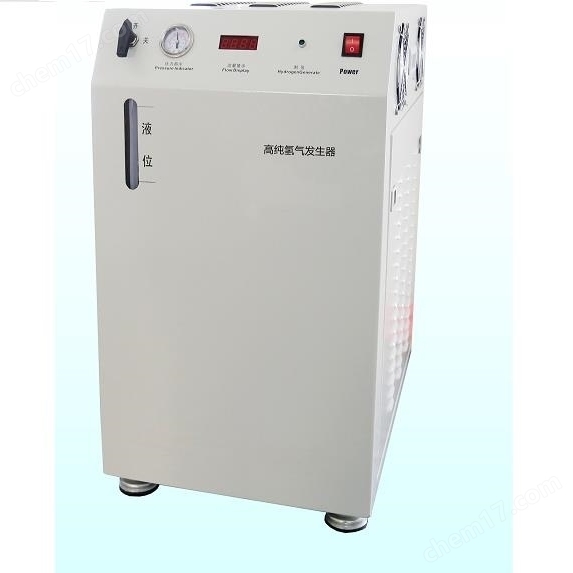
Energy consumption and gas production efficiency are key indicators for measuring equipment economy, directly related to long-term operating costs. The gas production efficiency is usually expressed as "unit energy consumption gas production", and the industry's advanced level can reach ≥ 2.5L/(kW · h), which means that for every 1 kWh of electricity consumed, no less than 2.5 liters of hydrogen can be produced. In large-scale chemical production, if the efficiency of a 1000L/min generator is increased by 0.1L/(kW · h), tens of thousands of yuan in electricity bills can be saved annually. Energy consumption control relies on efficient electrolysis technology, such as proton exchange membrane (PEM) electrolysis cells, which reduce energy consumption by 15% -20% compared to traditional alkaline electrolysis cells, and have a fast start-up speed, suitable for intermittent gas production scenarios, further optimizing energy utilization efficiency.
The safety performance indicators are the guarantee for high flow hydrogen generators, and a protective system needs to be constructed. The core safety indicators include pressure control accuracy, leakage alarm response speed, and explosion-proof level: pressure fluctuations should be ≤ ± 0.02MPa to avoid equipment damage caused by high pressure; When the concentration of hydrogen leakage reaches 1% VOL, the alarm response time should be ≤ 1 second, and the electrolysis power supply should be automatically cut off; In flammable and explosive environments such as chemical and mining, equipment must achieve an explosion-proof rating of Exd Ⅱ BT4 or higher. In addition, high-quality equipment is equipped with triple protection against overheating, overcurrent, and overvoltage, as well as emergency evacuation devices, to ensure that safety risks are reduced under abnormal working conditions.
Stability in operation and ease of maintenance are important indicators for enhancing the overall value of equipment. The convenience of maintenance is reflected in the consumable replacement cycle and operational difficulty. Equipment using long-life electrolytic membranes (with a service life of ≥ 20000 hours) and maintenance free compressors can extend the maintenance cycle to more than 6 months. At the same time, it is equipped with an intelligent operation and maintenance system that pushes consumable replacement reminders and fault diagnosis reports through an APP, reducing the threshold for operation and maintenance.
The performance evaluation of high flow hydrogen generators is a comprehensive consideration of "technical indicators+scenario requirements". From precise control of flow purity to comprehensive guarantee of energy consumption safety, each indicator carries the dual requirements of process stability and cost optimization. By focusing on core indicators and selecting suitable equipment, we can not only fully leverage the efficient gas supply advantages of hydrogen generators, but also provide safe, stable, and economical hydrogen sources for laboratory testing, industrial production, and other scenarios, helping various fields achieve efficient development.