-
E-mail
info@hechen-tech.com
-
Phone
13818517313
-
Address
Room 219, Building 2, No. 525 Yuanjiang Road, Minhang District, Shanghai
Hechen Technology (Shanghai) Co., Ltd
Have you paid attention to the parameter of effective pumping speed vs ultimate pumping speed for vacuum pumps?
Date: 2025-10-13Read: 0
Can the maximum pumping speed, maximum vacuum, corrosion resistance, and vacuum degree be displayed and controlled? Whenever people are selecting a suitable vacuum pump for their experimental setup, these parameters always come to mind first, but I don't know if anyone has paid attention to the concept of "effective pumping speed".
Effective pumping speed "refers to the actual measured gas volume flow rate at the inlet of the vacuum system's pumped container. Simply put, it is the pumping speed at which a vacuum pump truly acts on a vacuum chamber, taking into account the resistance of all connecting pipes, valves, cold traps, and other components. Its unit is usually liters per second (L/s) or cubic meters per hour (m ³/h).
The 'ultimate pumping speed' is the ideal pumping speed measured directly at the inlet of the vacuum pump without external resistance.
However, in actual vacuum systems, pumps are rarely directly connected to the chamber. There will always be components such as pipes, valves, and cold traps in the middle. These components will create resistance to the flow of gas, and due to the presence of these resistances, the actual pumping speed (i.e., "effective pumping speed") that can be obtained at the outlet of the chamber will be lower than the "ultimate pumping speed" at the inlet of the pump. In addition, as the pressure inside the container being pumped decreases, the "effective pumping speed" gradually decreases, and the pumping speed attenuation of different brands of vacuum pumps varies greatly.
The following figure is an example of the pumping curve (10 liter volume) of the MZ 1C chemical diaphragm pump from the German brand Vacuubrand at 50 Hz.
The maximum pumping speed of MZ 1C chemical diaphragm pump at 50 Hz is 0.75 m3/h, and the maximum vacuum is 12 mbar. From the figure below, it can be seen that under this test condition, when the vacuum degree is 20mbar, the effective pumping speed is around 0.4 m3/h.
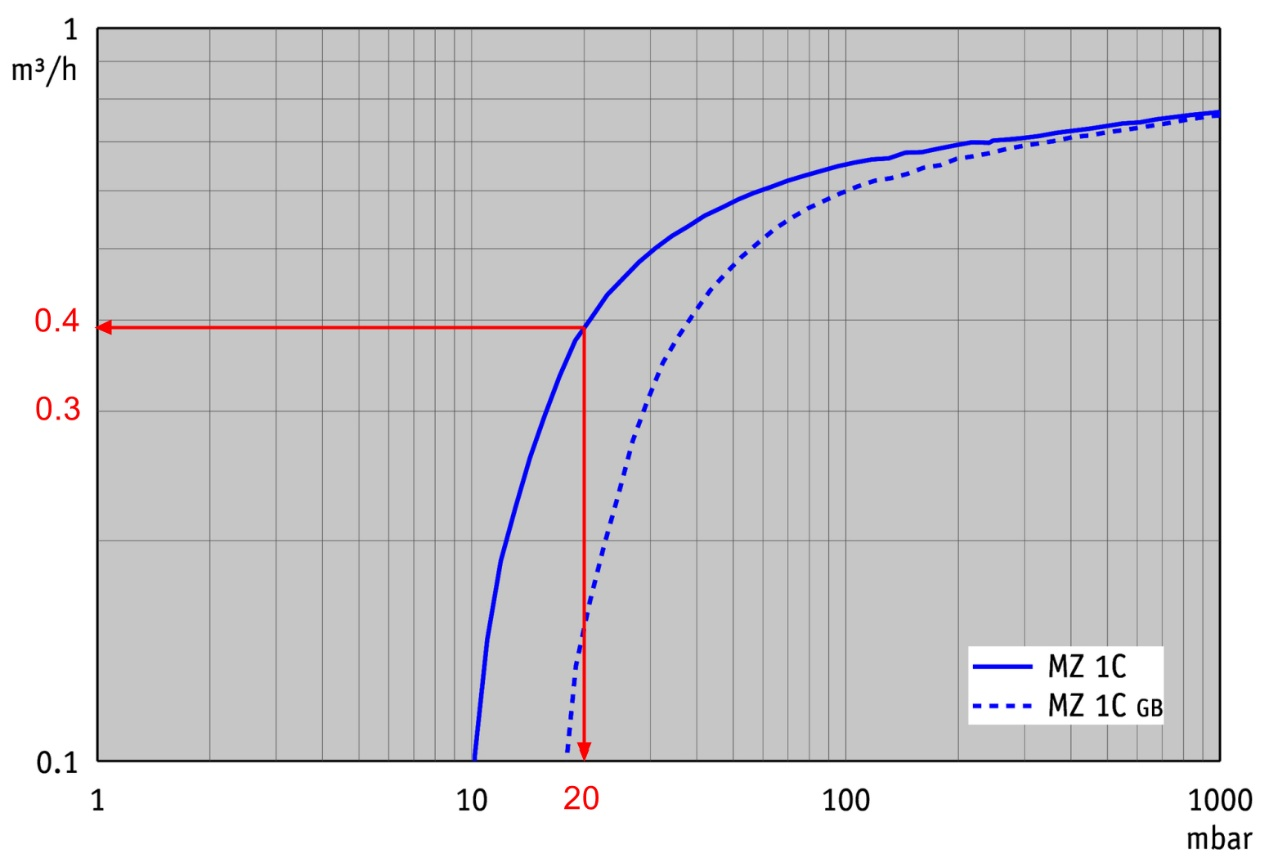
In order to test the significance of "effective pumping speed" in practical applications, a comparative experiment was conducted using MZ 1C and a vacuum pump from a foreign imported brand with a maximum pumping speed of 1.8 m3/h.
On the same rotary evaporator, using the same heating temperature and rotation speed, set the same vacuum degree value, and record the time taken for two vacuum pumps to evaporate 25ml of ethyl acetate.
Distillation test |
German Vacuubrand brand MZ 1C chemical diaphragm pump |
A certain foreign imported brand Chemical diaphragm pump |
Extreme pumping speed |
0.75 m3/h |
1.8 m3/h |
|
Steam dry 25ml under the same conditions Ethyl acetate usage time |
3.25 minutes |
5.5 minutes |
From the above experiment, it can be seen that even though the "maximum pumping speed" of the imported brand chemical diaphragm pump is 2.4 times that of the German Vacuubrand MZ 1C chemical diaphragm pump, in the actual distillation experiment mentioned above, the distillation speed of the MZ 1C chemical diaphragm pump is actually 1.69 times that of the imported brand chemical diaphragm pump.
As a common auxiliary equipment in laboratories, vacuum pumps should not only provide stable and reliable vacuum sources, but also assist you in improving experimental efficiency and shortening experimental time. The differences in "maximum pumping speed" and "effective pumping speed" of vacuum pumps of different brands and models vary. When selecting vacuum pump products, it is recommended that you also consider "effective pumping speed" to help you choose a sturdy, durable, efficient, and user-friendly vacuum pump.