-
E-mail
3169862401@qq.com
- Phone
-
Address
No. 58 Yangdong Road, Suzhou Industrial Park, Jiangsu Province
Havishan (Suzhou) Environmental Technology Co., Ltd
Principles, Applications, and Practical Guidelines of ORP Detector in Water Quality Testing
Date: 2025-12-19Read: 0
In the field of water quality testing, ORP tester (oxidation-reduction potential tester) is a key electrochemical analysis instrument used to measure the oxidation-reduction ability of water bodies. Its core indicator ORP value reflects the relative concentration of oxidized and reduced substances in the water body, measured in mV (millivolts), and is widely used in drinking water monitoring, sewage treatment, aquaculture, disease control laboratories and other scenarios.
1、 Working principle of ORP tester
The ORP tester consists of two parts: ORP electrode and display instrument, and works based on the principle of electrochemical oxidation-reduction reaction:
1. Electrode structure: The core consists of an indicator electrode (usually an inert precious metal such as platinum or gold) and a reference electrode (such as an Ag/AgCl electrode).
2. Reaction mechanism: When the electrode is immersed in the water sample, the redox substances in the water will undergo electron transfer on the electrode surface, generating a potential difference related to the redox potential; The reference electrode provides a stable reference potential, and the instrument directly outputs the ORP value by calculating the potential difference between the two.
·Positive ORP value (e.g.+200~+800 mV): Water has strong oxidizing properties and contains a high amount of oxidants (such as dissolved oxygen, residual chlorine, ozone);
·Negative ORP value (e.g. -200~-600 mV): Water has strong reducibility and contains a high amount of reducing agents (such as nitrite, sulfide, organic matter).
2、 Key application scenarios for ORP detection
1. Monitoring the disinfection effect of drinking water
·Chlorine and chlorine dioxide are commonly used for disinfection of tap water, and the ORP value can directly reflect the disinfection effect:
The ORP value in drinking water should be maintained at+650~+750 mV, at which point pathogenic bacteria and viruses in the water can be effectively killed;
·If the ORP value is too low, it indicates insufficient residual chlorine and a risk of microbial exceedance, which is one of the core indicators of the CDC water quality survey.
2. Control of sewage treatment process
·Anaerobic tank: ORP value should be controlled between -300~-500 mV to ensure anaerobic bacterial activity and efficient degradation of organic matter;
·Aerobic pool: ORP value should be maintained at+200~+400 mV to ensure aerobic bacteria oxidize and decompose pollutants;
·The online ORP tester can provide real-time feedback on the redox status in the tank and automatically adjust the aeration or chemical dosage.
3. Aquaculture water quality management
The ORP value of fish and shrimp aquaculture ponds directly affects the survival of aquatic organisms:
·The suitable range is+200~+400 mV, where the dissolved oxygen in the water is sufficient and the content of harmful substances (such as ammonia nitrogen and hydrogen sulfide) is low;
·If the ORP value is below+100 mV, it is easy to cause hypoxia and disease outbreaks in fish and shrimp. Portable ORP testers can help farmers quickly inspect.
4. Industrial water treatment (such as pharmaceuticals, electroplating)
·Pharmaceutical industry: ORP testing of purified water and injection water can monitor residual oxidants in water to ensure that water quality meets pharmacopoeia standards;
·Electroplating industry: Control the redox environment of the plating solution through ORP value to ensure the uniformity of the coating.
3、 Core precautions for using ORP tester
1. Temperature compensation
The ORP value is significantly affected by temperature, with a change of about 5-8 mV for every 1 ℃ increase in temperature. High quality testers (such as Hash and Havelson models) are equipped with automatic temperature compensation (ATC) function, and it is necessary to ensure that this function is turned on to obtain accurate data.
2. Electrode calibration and maintenance
·Calibration method: Use standard ORP buffer solution (such as+220 mV,+468 mV buffer solution) for two-point calibration. Before calibration, rinse the electrode with ultrapure water to avoid contamination;
·Daily maintenance:
The surface of the indicator electrode should be kept clean. If dirt adheres, it can be wiped with dilute hydrochloric acid or specialized electrode cleaning solution;
The reference electrode needs to be regularly replenished with electrolyte (such as KCl solution) to avoid electrode drying and failure;
When not in use for a long time, the electrode needs to be soaked in a saturated KCl solution for storage.
3. Avoidance of interference factors
·Heavy metal ions and high concentrations of organic matter in water samples may contaminate the electrode surface, leading to delayed response. Pre treatment of the water sample is necessary;
·Avoid electrode contact with bubbles or stirring too quickly during testing to prevent potential fluctuations.
4、 Comparison of mainstream brands in the industry
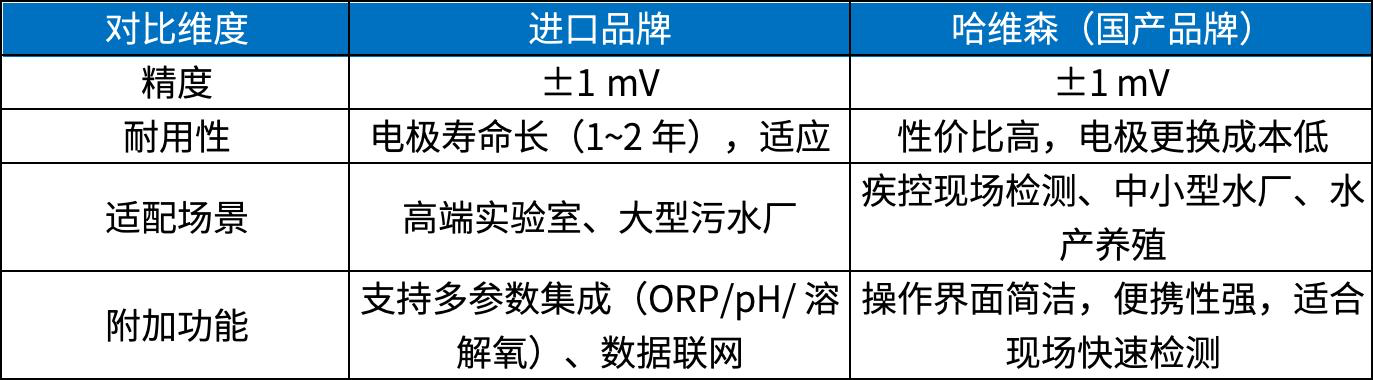
In summary, ORP testers have become the core equipment for water quality monitoring in various industries due to their accurate feedback on the redox status of water bodies. The selection and standardized use of ORP testers directly affect the reliability and adaptability of detection data to different scenarios.

Choosing the domestically produced ORP tester from Havishan can not only accurately control the oxidation-reduction status of water quality, ensure water quality safety and process compliance, but also effectively control procurement and operation costs, truly achieving "maximum cost-effectiveness". Whether it is a small testing institution that is just starting out, or a small and medium-sized enterprise and breeder that focuses on cost-effectiveness, Havelson can provide suitable ORP testing solutions to help easily complete water quality monitoring work.