-
E-mail
hzjoule@163.com
-
Phone
19012707638
-
Address
No. 598 Hejing Road, Hezhuang Street, Qiantang District, Hangzhou City, Zhejiang Province
Hangzhou Joule Intelligent Technology Co., Ltd
Sample Collection | Exploring the Secrets of Thermal Performance in Multiple Industries
Date: 2025-08-06Read: 0
Differential scanning calorimeter
Starry
The sample collection activity has been fully launched
At the forefront of materials science and industrial research and development, differential scanning calorimetry (DSC), as a core tool for thermal analysis, is unlocking new development possibilities for many industries with its accurate heat flow measurement and profound material insights. To further expand the application boundaries of DSC technology, we are now conducting a sample collection activity for various industries, inviting you to explore the unlimited potential of material thermal properties together.
What problems can DSC help you solve?
Accurate qualitative and quantitative analysis: Determine phase transition information such as melting point, crystallization temperature, and glass transition temperature (Tg) of materials.
Insight into material stability: Evaluate the thermal stability, oxidation stability, curing/crosslinking degree of materials, predict product life and usage risks.
Composition analysis&compatibility: Analyze purity, polymorphs, compatibility of blends, and the influence of additives/fillers.
Optimize production process: guide the setting of curing process (epoxy resin, etc.), injection molding parameters, annealing conditions, drying process, etc.
Material Failure Traceability: Helps identify the thermodynamic roots of issues such as cracking, deformation, discoloration, and performance degradation.
02 Sample collection focuses on the industry (not limited to this)
Polymer materials: plastics, rubber, elastomers, resins, films, fibers, coatings, adhesives, composite materials (phase transition, Tg, curing, oxidation, aging, crystallinity, compatibility).
Pharmaceutical and Life Sciences: Screening of drug polymorphs, compatibility of excipients, protein denaturation, liposome phase transition, thermal stability of biomaterials (such as implants).
New energy materials:
Lithium batteries: research on electrolyte thermal stability, decomposition of positive/negative electrode materials, formation of SEI film, thermal shrinkage of separator, and thermal runaway.
Photovoltaics: EVA film curing, backplate material properties, thermal stability of packaging materials.
Food science: Oil oxidation induction period (OIT), starch gelatinization/retrogradation, protein denaturation temperature, chocolate phase transition, glass transition (affecting shelf life).
Petrochemical industry: wax content, asphalt phase transition, thermal decomposition of oil products, thermal stability of lubricating oil, evaluation of additives.
Electronic and electrical engineering: melting point of solder, performance of packaging materials (Tg, curing), thermal stability of insulation materials, performance of thermal conductive materials.
Daily chemicals: stability of cosmetic raw materials (oil, wax), composition analysis of detergent, thermal behavior of essence and fragrance.
Metal materials (partial applications): alloy solution/precipitation temperature, shape memory alloy phase transition, melting and solidification behavior.
Nanomaterials and cutting-edge technology: characterization of thermal properties of novel functional materials (MOFs, perovskites, etc.).
03 Participation Method
Multi channel parallelism ensures smooth service.
Online registration
Scan the QR code to fill in sample information

04 Activity Deadline
The validity period of this sample collection is 6 months (from August 5, 2025 to February 5, 2026)
Differential scanning calorimeter
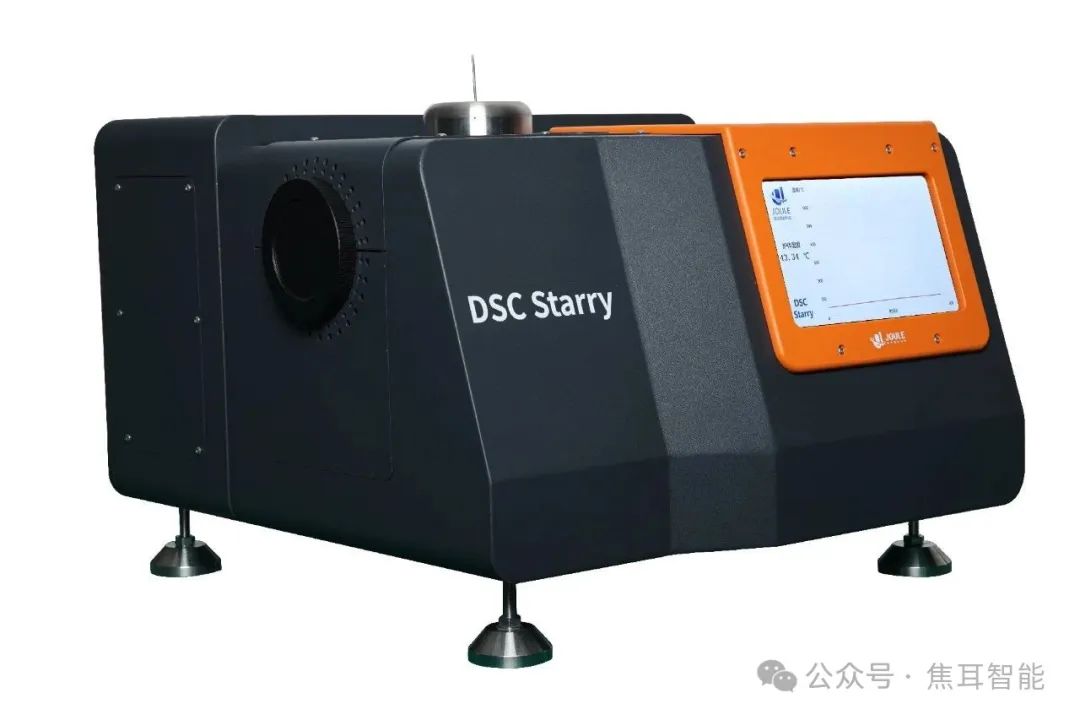
Differential scanning calorimeter is a thermal analysis technique that measures the temperature or time variation of the thermal flow difference (or power difference) between a sample and a reference sample per unit time under programmed temperature control.
Technical Specifications:
parameters
Temperature range: -80 ℃~725 ℃ (silver furnace body)
Reproducibility of phase transition temperature: 0.006K
Temperature accuracy: ± 0.01K
Heating scanning rate: 0.02-300K/min
Cooling scanning rate: 0.02~50K/min
Program heating rate deviation: 1% (ASTM E967-18)
Baseline stationarity: 60 μ W (RT~300 ℃)
Measurement accuracy of enthalpy: 0.02% (Indium)
Heat flow display resolution: 0.1 μ W
Peak to peak heat flux noise: 10 μ w
Heat flow measurement range: ± 750mW
Indium peak height/half width: 25mW/K
Modulation DSC function: available
System sampling rate: 50Hz
Blowing atmosphere system: Yes
Blowing atmosphere control: controllable flow rate (0-300ml/min)
Optional features:
Optional function
Automatic injection: 60 positions
Primary refrigeration unit: -35 ℃
Secondary refrigeration unit: -80 ℃
Prototype: Customized
Standard sample: second-class standard substance
Sapphire: Customized
Solid aluminum crucible: customized
High pressure sealed crucible: customized
Liquid nitrogen refrigeration module: -150 ℃
High voltage module: 7MPa
Typical applications:
Typical applications
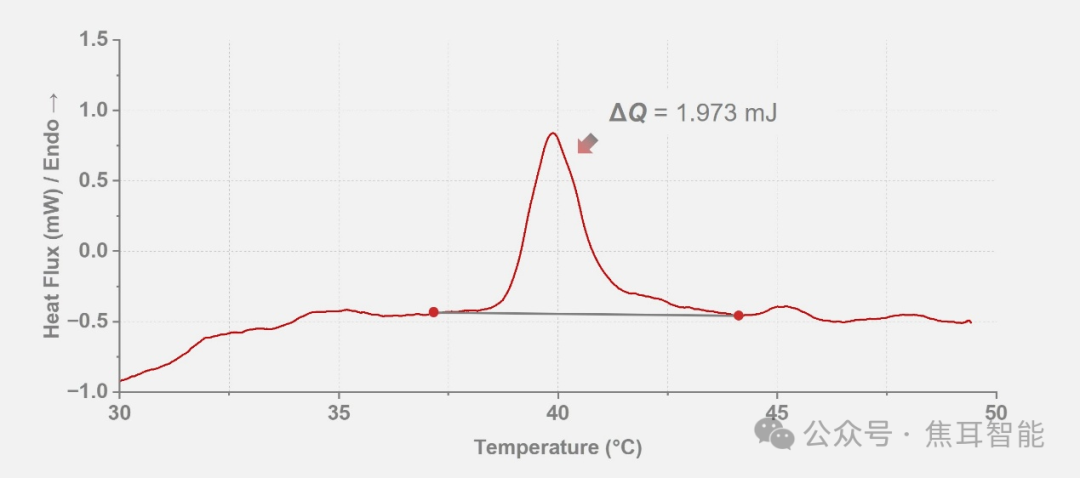
Rb sample atomic gas chamber heat flux curve

Glass transition temperature of thermoplastic resin

Glass transition temperature test of adhesive

Melting peak of indium metal