-
E-mail
3356056332@qq.com
-
Phone
15088734782
-
Address
No.1, Road 10, Dongzhou Industrial Park, Fuyang District, Hangzhou City, Zhejiang Province
Download
Hangzhou Jinghao Machinery Co., Ltd
Ultrasonic dispersion equipment
Date: 2020-03-06Read: 0
Product Introduction
| brand | Jinghao | type | Ultrasonic dispersion |
|---|---|---|---|
| Speed category | Step by step transmission (multi speed) | Variable speed mode | other |
| speed range | Below 400rpm | Application field | Environmental protection/water industry, biotechnology industry, petroleum/chemical industry, pharmaceuticals/cosmetics |
Jinghao Ultrasonic Dispersion Equipment
Both factories and research institutions can negotiate and design the entire product and functional settings.
We can customize a complete set of equipment for customers, including reaction vessels and ultrasonic dispersion devices
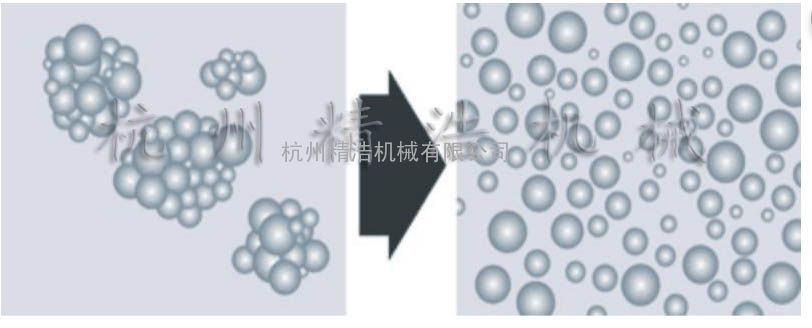
The core content of nanotechnology is how to solve the problem of nanoparticle aggregation. Due to the easy aggregation of nanoparticles themselves, it is very difficult to obtain single dispersed nanoparticles. How to evenly disperse nanoparticles into the matrix is the key technology of nanotechnology.
Hangzhou Jinghao Machinery Co., Ltd. specializes in customizing various complete sets of equipment for customers, including mixing reactors, refrigeration and heating units, pipeline matching systems, and more.
detailed introduction
Jinghao Ultrasonic Dispersion Equipment
Ultrasonic nano homogenizer
The driving force behind the innovation of nanotechnology is the application of nanomaterials, which in turn increases the requirements for materials
The core content of nanotechnology is how to solve the problem of nanoparticle aggregation. Due to the easy aggregation of nanoparticles themselves, it is very difficult to obtain single dispersed nanoparticles. How to evenly disperse nanoparticles into the matrix is the key technology of nanotechnology.
In recent years, ultrasound has become an increasingly popular application of emerging technologies.
Both factories and research institutions can negotiate and design the entire product and functional settings.
We can customize a complete set of equipment for customers, including reaction vessels and ultrasonic dispersion equipment, as well as other peripheral devices such as level gauges, Mark heating and cooling units, peristaltic pumps, etc. The material of the reaction vessel can be single-layer and double-layer glass, stainless steel, or other special materials.
Hangzhou Jinghao Machinery Co., Ltd. specializes in customizing various complete sets of equipment for customers in the field of ultrasound.
The product is suitable for dispersing, crushing, wet grinding, organic material decomposition, sample preparation for extraction experiments, and deep mixing of solid particles in liquids. The dispersion, crushing, wet grinding, decomposition of organic materials, sample preparation for extraction experiments, and deep mixing of materials of solid particles in liquids. Preparation of very fine emulsions and suspensions, deep mixing and dissolution of solids and liquids, extraction of finely refined components from aerosols, fibrous tissues, and cells.
Device Model |
JH1000-20 |
JH1500-20 |
JH2000-20 |
JH2600-20 |
power |
1000W |
1500W |
2000W |
3000W |
Frequency(KHz) |
20KHz |
|||
output power/amplitude |
50%-100% |
|||
Processing capacity(L) |
5-300 |
|||
Temperature requirements |
≤70℃ |
|||
Probe diameter(mm) |
50 |
|||
General Configuration |
The ultrasonic generator+超声波探棒 |
|||
Optional configuration |
Customized reaction tank+control cabinet+soundproof box+remote control+alarm output |
|||
JinghaoApplication of Ultrasonic Dispersion Equipment
The early application of ultrasonic nano homogenizers should be to use ultrasound to crush cell walls and release their contents. Low intensity ultrasound can promote biochemical reaction processes, such as using ultrasound to irradiate liquid nutrient media can increase the growth rate of algal cells, thereby increasing the amount of protein produced by these cells by three times.
The ultrasonic nano disperser consists of three main parts: ultrasonic vibration components, ultrasonic driving power supply, and reaction kettle. Ultrasonic vibration components mainly include ultrasonic transducers, ultrasonic amplitude rods, and tool heads (emission heads), which are used to generate ultrasonic vibration and emit the vibration energy into the liquid. The transducer converts the input electrical energy into mechanical energy.
Its manifestation is that the ultrasonic transducer moves back and forth longitudinally, with an amplitude generally in the range of a few micrometers. This amplitude power density is not sufficient and cannot be directly used. The amplitude rod amplifies the amplitude according to the design requirements, isolates the reaction solution and transducer, and also serves to fix the entire ultrasonic vibration system. The tool head is connected to the amplitude rod, and the amplitude rod transmits ultrasonic energy vibration to the tool head, which then emits the ultrasonic energy into the chemical reaction liquid.
Dispersion machine type: Ultrasonic dispersion
Material Type: Liquid Liquid
Technical parameter table of ultrasonic nano dispersion system:
1. Power supply/generator: power output; 2000W frequency; 20KHZ
Continuous adjustable mode
2. Ultrasonic transducer: piezoelectric ceramic diameter: 50mm
Output power: 1000W
3. Standard launch head: Titanium alloy material grade: TI-6AL-4V
Diameter: 16mm Shape: Rod type
4. Power supply: 220V, 50/60HZ
Comparison chart of different dispersion methods: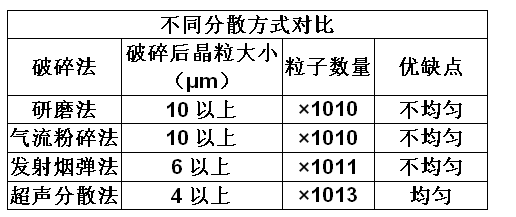
Manufacturer supplies ultrasonic nano dispersion system components
1. CNC power supply: Convert 50-60Hz mains power into high-power high-frequency power supply and provide it to the transducer.
2. Ultrasonic transducer: converts high-frequency electrical energy into mechanical vibration energy.
3. Variable amplitude pole: Connect and fix the transducer to the tool head, amplify the amplitude of the transducer, and transmit it to the tool head.
4. Tool head (inlet rod): It transmits mechanical energy and pressure to the workpiece, and also has the function of amplitude amplification.
5. Connecting bolts: Connect the above components tightly.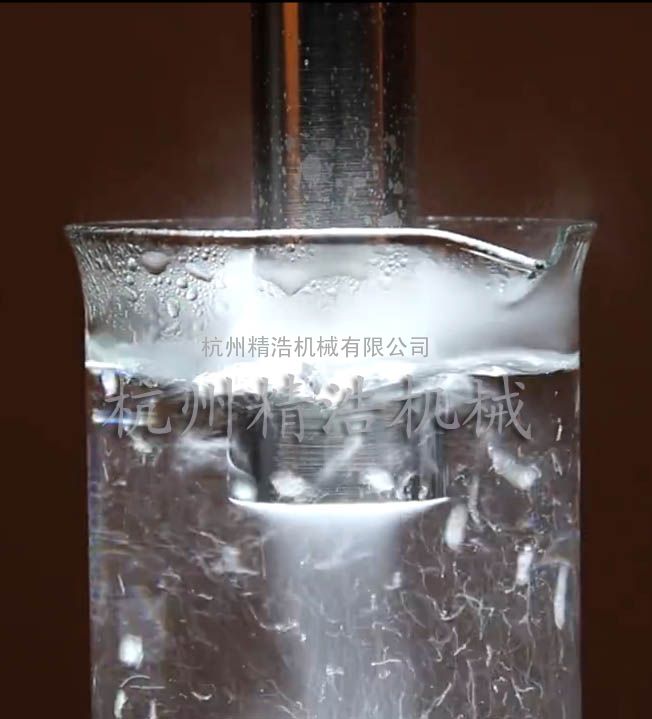
:Ultrasonic technology, as a physical means and tool, can generate a series of similar conditions in the medium of chemical reactions. Energy can not only excite or promote many chemical reactions, accelerate the rate of chemical reactions, but also change certain conditions
The direction of chemical reactions produces some unexpected effects and miracles. Ultrasonic focused nanoscale agitators can be applied to almost all chemical reactions, such as extraction and separation, synthesis and degradation, biodiesel production, microbial treatment, degradation of toxic organic pollutants, biodegradation treatment, biological cell crushing, dispersion and coagulation, etc. The energy density of ultrasonic sound field is increased by trillions of times compared to the energy density when cavitation bubbles collapse, causing a huge concentration of energy; The sonochemical phenomenon and sonoluminescence caused by high temperature and pressure generated by cavitation bubbles are the forms of energy and substance exchange in sonochemistry. Therefore, ultrasound plays an increasingly important role in chemical extraction, biodiesel production, organic synthesis, microbial treatment, degradation of toxic organic pollutants, chemical reaction rate and yield, catalytic efficiency of catalysts, biodegradation treatment, ultrasonic scale prevention and removal, biological cell crushing, dispersion and aggregation, and sonochemical reactions. The entire ultrasonic dispersion system can be designed and customized according to specific customer requirements.