-
E-mail
sales@morotchem.com
-
Phone
19884159221
-
Address
Ivy Health Industry Park, Yuhang District, Hangzhou City, Zhejiang Province
Hangzhou Borealis Chemical Technology Co., Ltd
The latest JACS! A new method for Pd catalyzed O-arylation of phenols, assisted by continuous flow technology for efficient synthesis
Date: 2025-10-13Read: 3
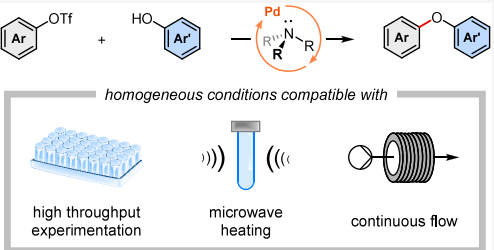
In the field of organic synthesis, diaryl ethers are a crucial structural unit widely present in natural products, pharmaceuticals, and agricultural chemicals. For a long time, researchers have been exploring efficient methods for synthesizing diaryl ethers, among whichPdcatalyticC-OCross coupling reaction is one of the commonly used strategies. However, traditional methods rely on insoluble inorganic bases, resulting in heterogeneous reaction systems that not only have poor reproducibility across different scales and laboratories, but are also incompatible with many modern empowerment technologies. However,Martyna I. OstrowskaTheJames A. MorrisandLiam T. BallThe team's latest research has brought breakthrough progress, as they have developed a homogeneous approachPdCatalytic synthesis of phenols and aromatic trifluoromethanesulfonic acid estersC-OCoupling reactions have shown great potential in the application of continuous flow technology.
The dilemma of traditional methods: many difficulties in heterogeneous reactions
traditionPdThe catalytic synthesis of diaryl ethers involves the use of insoluble inorganic bases, resulting in a solid-liquid biphasic state of the reaction system. There are many problems with this heterogeneous system:
Mass transfer sensitivity:The mass transfer in solid-liquid two-phase is extremely sensitive to stirring efficiency, and during large-scale production in factories, careful reactor design is required to ensure mass transfer efficiency; Meanwhile, the size and morphology of alkali particles may vary across different batches and reaction processes, further affecting mass transfer.
repeatPoor sex:Due to the influence of multiple factors and instability on mass transfer, when the reaction is switched between different laboratories or scales,repetitivenessThe problem is very common and brings great difficulties to scientific research and production.
Incompatible with empowerment technology:In high-throughput experiments, commonly used orbital oscillations or rolling agitation are difficult to fully mix heavy suspensions, resulting in reduced reaction activity“trend”Cannot be reproduced in terms of preparation scale; During microwave heating, poor mixing can result in uneven exposure of the sample to the magnetic field, creating a temperature gradient inside the reaction vessel. This not only causes temperature measurement errors that affect reproducibility, but may also lead to local overheating, causing uncontrolled heating and even explosions; When transitioning from batch reactions to continuous flow reactions, the reactor is prone to clogging and typically requires specialized technical intervention to resolve. In addition, regardless of the scale and form of the reaction, monitoring reactions in heterogeneous systems is challenging and not conducive to reaction optimization, mechanism research, and process control.
Innovative solution: homogeneousPdCatalytic reaction system
To address the drawbacks of traditional methods, the research team has developed a homogeneous system using weakly soluble tertiary amines as basesPdThe catalytic system has the following key advantages:
Homogeneous reaction environment:The use of soluble organic bases to make the reaction mixture homogeneous fundamentally solves the problems of mass transfer and reproducibility in heterogeneous systems.
Precise regulation of reaction conditions:By carefully selecting ligands, aryl electrophilic reagents, and bases, side reactions and catalyst poisoning were effectively avoided, achieving efficient catalytic reactions. Research finds thatAdBippyPhos(L28)WithPMPThe combination exhibits excellent performance in the reaction, significantly improving reaction efficiency and selectivity.
Wide substrate applicability:This method has good compatibility with various aromatic trifluoromethanesulfonic acid esters and phenolic substrates. Whether it is substrates with electron donating groups, electron withdrawing groups, or ortho substituents, most of them can obtain the target product with good to excellent yields. For some complex natural product derived phenols, this method can also be used to quickly construct complex diaryl ether structures.
Core highlight: Successful application of continuous flow technology
Among its many advantages, this method has shown particularly outstanding performance in the application of continuous flow technology, becoming an important breakthrough in promoting the high efficiency and scale of synthetic chemistry
Seamless conversion without additional optimization:The research team utilizes“Microwave to continuous flow”Mode, converting the reaction directly from microwave batch reaction to continuous flow reaction without the need for additional reaction condition optimization. Industrial related target products——acetyl-CoAACarboxylase inhibitor Fluconazole(fluazifop)For example, in batch reactions, both microwave heating and conventional heating (changing the solvent to high boiling point benzyl ether) can yield the target product with excellent yields. Directly applying this reaction to a continuous flow system has also achieved good results.
Efficient and high-yielding, suitable for large-scale production:Under continuous flow reaction conditions, less than30With just a few minutes of operation time, you can obtain more than1Ke's fluorine grass tobacco has a separation yield of up to76%Converted into daily output, it can reach53Ke. This efficient production capacity has laid a solid foundation for the application of this method in industrial scale production.
The device is simple and easy to promote:The continuous flow experimental setup is extremely simple. All reagents are loaded into a single syringe in air and then immersed in a silicone oil bath using standard polytetrafluoroethylene(PTFE)Heating the coil can complete the reaction. Without the need for complex equipment such as mixing tees, back pressure regulators, or advanced pumps, even laboratories without experience in continuous flow chemistry can easily conduct relevant experiments, greatly reducing the application threshold of continuous flow technology and facilitating the widespread promotion of this method.

Reaction mechanism research: providing theoretical support for reaction optimization
The in-depth study of the reaction mechanism provides important theoretical basis for the optimization and application of this method
catalystresting stateRegarding the determining step: Through the study of reaction kinetics and analysis of the linear free energy relationship, the catalytic activity of the catalyst has been determinedresting stateFor aryl palladium phenolates(Ⅲ)The reduction and elimination step is the decisive step in the reaction. This discovery provides a clear direction for further optimizing reaction conditions and increasing reaction rates.
The impact of electronic effects:HammettThe graph analysis shows that the reaction rate is sensitive to the electronic properties of both aryl trifluoromethanesulfonic acid esters and phenolic substrates. Aromatic trifluoromethanesulfonic acid estersHammettconstantρFor positive values(+1.75), indicating that electron withdrawing groups are beneficial for the reaction to proceed; Phenolic compoundsHammettconstantρNegative value(-2.21)The electron donating group can promote the reaction. Based on this law, researchers can optimize the reaction efficiency by selecting substrates with appropriate electronic properties. For example, when the reaction effect between electron poor phenols and electron neutral trifluoromethanesulfonic acid esters is poor, the electron rich aromatic moiety can be used as the phenol, and the electron poor moiety can be used as the trifluoromethanesulfonic acid ester, thereby achieving efficient coupling.
Summary and Outlook
The homogeneous development of this researchPdCatalytic phenolsO-The arylation method not only solves many problems in traditional heterogeneous reactions, but also makes significant breakthroughs in the application of continuous flow technology. Its simple equipment requirements, efficient reaction efficiency, and wide substrate applicability make it have enormous potential for application in both scientific research and industrial production. In the future, with the further improvement and promotion of this method, it is expected to bring revolutionary changes to the synthesis of diaryl ether compounds, promoting rapid development in fields such as drug research and agricultural chemical production. At the same time, this study also provides valuable reference experience for the optimization of other cross coupling reactions and the application of continuous flow technology, which will help synthetic chemistry move towards a more efficient, green, and large-scale direction.
Zhejiang Borels Continuous Flow Photochemistry: A Technological Tool Empowering Efficient Synthesis
The Continuous Flow Photoelectrochemical Technology of Zhejiang Brillis, andOstrowskaThe concept of continuous flow empowerment synthesis in team research is highly compatible with phenolic compoundsO -Aromatization and other reactions provide efficient solutions. The photochemical plate reactor adopts three-dimensional microchannels etched by femtosecond laser, combined with a high transmittance glass cavity, to achieve full contact between reactants and photons, greatly improving mass transfer efficiency.
This technical support 254-950nmFlexible wavelength adjustment, combined with±0.1℃The precise temperature control and intelligent monitoring system can adapt to the fine control requirements of homogeneous catalytic systems, solving the problems of low reaction efficiency and poor reproducibility in traditional reactions. Modular design enables seamless transition from small-scale testing to ton level production.

Brevis plate microchannel photopolymerization reactor