-
E-mail
903371275@qq.com
-
Phone
15858111738
-
Address
2nd Floor, Building 8, Huoshui Industrial Park, No. 95 Binwen Road, Binjiang District, Hangzhou City
Hangzhou Blue Sky Instrument Co., Ltd
Programmable vacuum tube furnace has automatic constant temperature and time control functions
Date: 2025-09-28Read: 0
Programmable energy-saving vacuum tube furnaceHigh quality high-temperature quartz material is used as the furnace tube, and low heat storage and high radiation lightweight fiber material is used to make the heating furnace liner, which is efficient and energy-saving. High quality high-temperature heating wire is used as the heating element, which can heat up to 1000 degrees in 15 minutes. The control system is an LTDE programmable instrument with *, which can freely set multi band operations such as temperature rise and fall, constant temperature, timed power on, and power off. The controller is located below the furnace body and is made in an integrated manner. The electrical connection between the furnace body and the temperature controller is completed before leaving the factory. It can be used by turning on the power supply. The control system uses LTDE programmable instruments with adjustable heating speed, and the PID+SSR system synchronizes and coordinates control, making it possible for any experiment or experiment to be accurate and reproducible. It has automatic constant temperature and time control functions, and is equipped with a second level over temperature automatic protection function, ensuring reliable control and safe use. The sealing system is equipped with a dual head inlet valve, a single head outlet valve, a vacuum gauge, a stainless steel sealing head, and a high-temperature resistant sealant, with good sealing performance. If necessary, a flow meter and a water cooling device can also be added. This vacuum furnace is aesthetically pleasing and has excellent performance, making it the first vacuum tube electric furnace among research institutions in various universities.
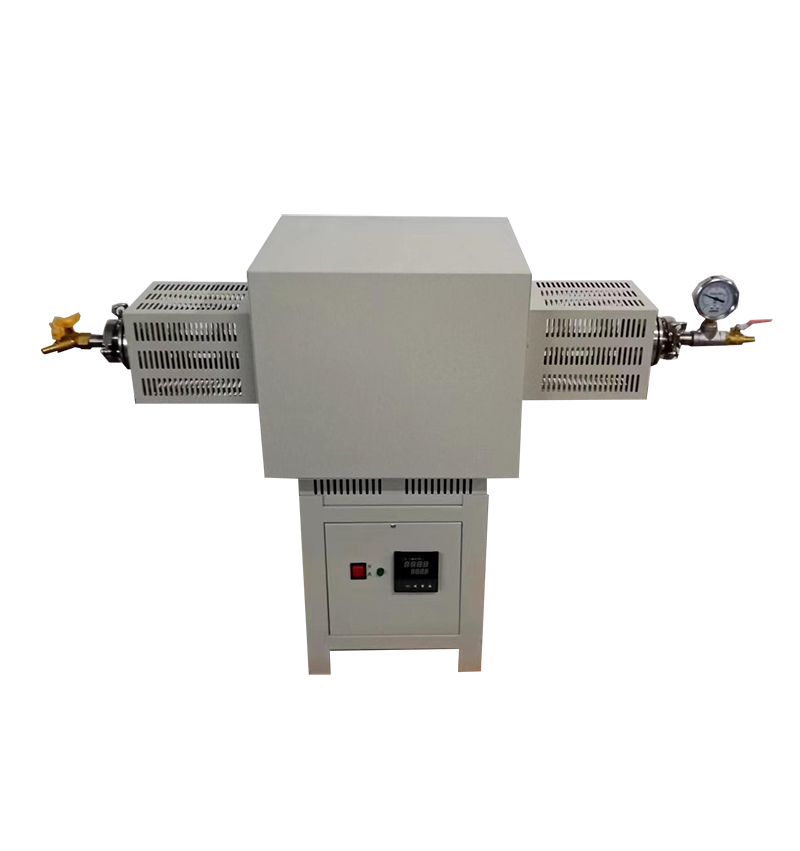
Programmable energy-saving vacuum tube furnaceHeat treatment techniques:
1. When processing titanium alloys in a vacuum furnace, nitrogen should not be used as a cooling gas because titanium and nitrogen react at high temperatures to form golden titanium nitride.
2. The active connection parts of the vacuum furnace are all sealed with O-rings, and this part is cooled by water.
3. When workpieces are quenched in a vacuum state, vacuum quenching oil should be used, which has a lower saturation vapor pressure.
4. The maintenance of the vacuum furnace should be carried out in a vacuum or pure nitrogen state, avoiding suction and moisture absorption when not in use.
5. The pressure rise rate of domestic vacuum furnaces should not exceed 1.33Pa/h, while the standard for some foreign enterprises is 0.67Pa/h
6. Vacuum heating is mainly based on radiation, and the workpiece should be kept at a distance inside the furnace.
7. During the heating process, the workpiece and materials inside the furnace will release gas, causing a decrease in vacuum degree.
8. The heating temperature for vacuum tempering, vacuum annealing, vacuum solution treatment, and vacuum aging is generally the same as that for conventional treatment.
9. The vacuum tempering furnace should have a fast cooling device. The pressure of the cooling water should be greater than 0.2Mpa, and the flow rate should be adjustable.
10. Cooling gas: Vacuum furnace steel generally uses nitrogen with a purity of 99.995%, high-temperature alloys use nitrogen or argon with a purity of 99.999%, and titanium alloys use argon with a purity of 99.995%.
11. Heating up: After placing the workpiece, it is usually preheated to 6.67Pa before heating up.
Programmable energy-saving vacuum tube furnaceIt has automatic constant temperature and time control functions, and is equipped with a second level over temperature automatic protection function, ensuring reliable control and safe use. The sealing system is equipped with a dual head inlet valve, a single head outlet valve, a vacuum gauge, a stainless steel sealing head, and a high-temperature resistant sealant, with good sealing performance. If necessary, a flow meter and a water cooling device can also be added. This vacuum furnace is aesthetically pleasing and has excellent performance, making it the first equipment for research institutions in various universities.