-
E-mail
ec@hkaco.com
-
Phone
13412598543
-
Address
Science City, Huangpu District, Guangzhou City
Guangzhou Hongke Electronic Technology Co., Ltd
Droplet microfluidic technology for high-throughput cell and protein encapsulation
Date: 2025-12-11Read: 0
Droplet microfluidics for high-throughput cell and protein encapsulation
1 Introduction
Droplet generation is a powerful technique for biomedical researchers to obtain high-throughput and low-cost analysis[1] . Scientists have improved cell and protein encapsulation methods using microfluidic techniques. The advancement of these technologies has brought promising results for the treatment of various diseases. This article will discuss the application of droplet generation in cell and protein encapsulation. We will also show you everything you need to fully utilize the experiment.
1.1 Microfluidic technology based on droplets

Droplet based microfluidic technology is a method of generating tiny droplets by introducing two immiscible fluids into a microfluidic channel. Usually, researchers manipulate the geometry of channels and adjust their continuity/The flow rate of the dispersed phase is used to control the droplet size, [2]。
Micro scale droplets have faster mixing and heat transfer rates, thereby accelerating reaction times. These isolation chambers function similarly to microreactors. In addition, they provide a physically and chemically isolated environment to avoid cross contamination between cells, enabling single-cell encapsulation, cultivation, and analysis[2]。
This technology has multiple advantages, such as:
lDesign a workflow for whole cell screening
lLow reagent consumption
lbiocompatibility
lhigh sensitivity
Droplet encapsulation includes various technologies. This method varies depending on the type and quantity of samples, as well as the required chemical reaction time and sequence. Mainly involves diluting the sample into a dispersed phase of droplets.
1.2 Protein encapsulation
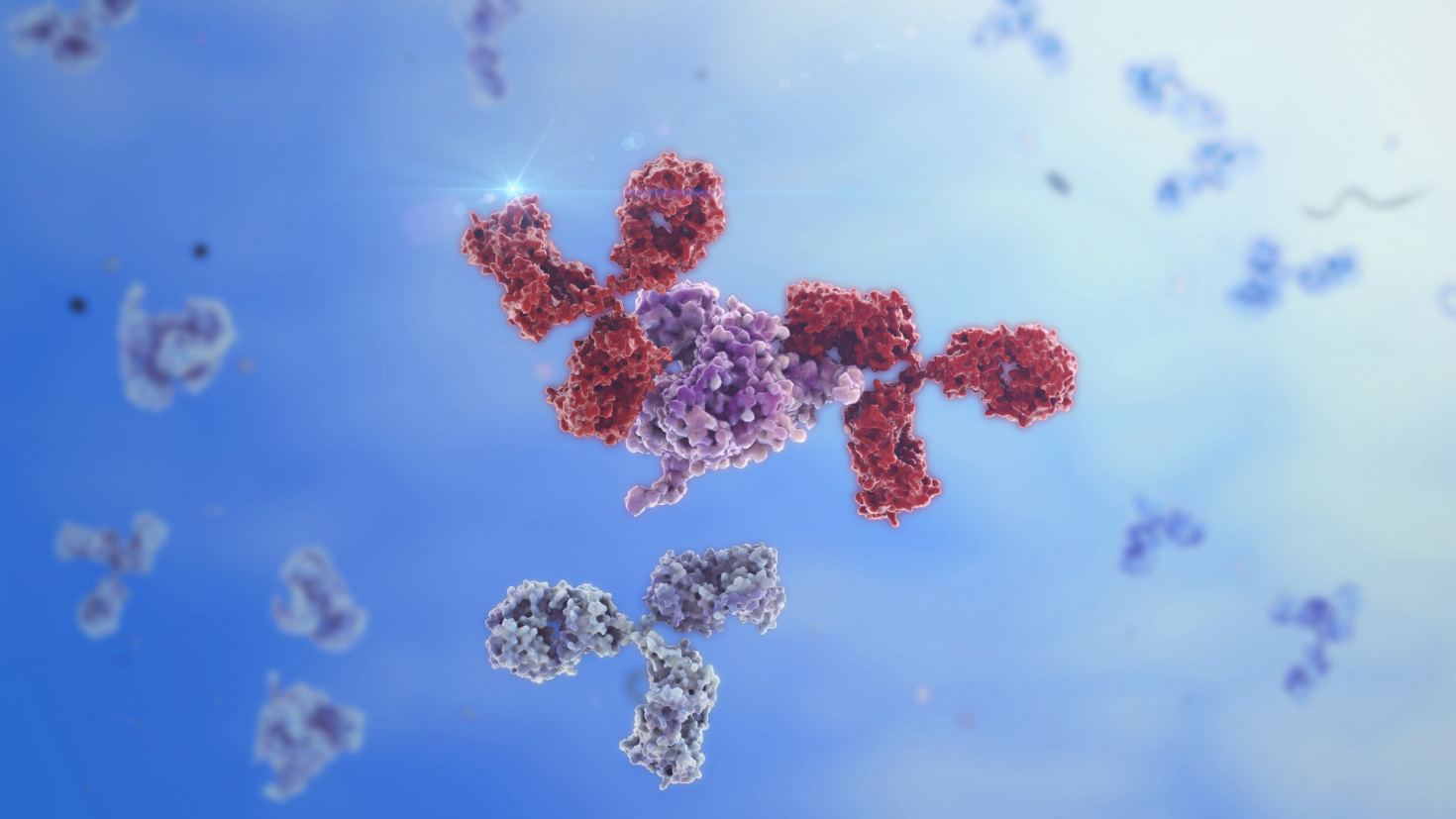
Encapsulation of proteins in microspheres is a promising therapeutic strategy for treating various diseases[1] . Protein therapy is extremely sensitive to enzyme degradation. Therefore, encapsulating them in a carrier can provide protection when they are delivered to the target site in the body [3].
The two common strategies for obtaining protein nanoparticles are nanoprecipitation and emulsification. Another method is emulsification, followed by solvent consumption and solvent diffusion. Microfluidic platforms can make the process more efficient and provide more controllable drug release rates[3]。
This technique allows researchers to determine whether the/Enzyme degradation is used to customize the release rate of encapsulated proteins.
1.3 Single cell encapsulation in droplets
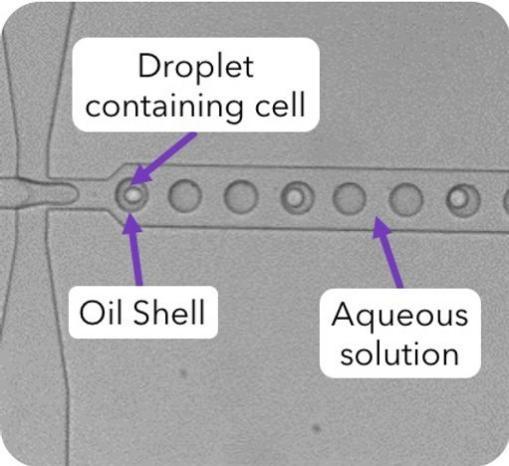
Microcapsulation of cells typically involves the use of alginates. However, this material has limited control over the cellular microenvironment. A microfluidic method for generating size controlled synthetic micro gel can help solve this problem. This technology can accurately control droplet size and can be used to manufacture thin films 6 µ m micro gel [1].
Scientists can use microfluidics to encapsulate cells from human patients and cultured cell lines in droplets at high flux rates. Especially, droplet based single-cell technologies can bring benefits as they allow researchers to manipulate individual cells in isolated microenvironments[2]。
Usually, droplets contain a solution of water and cells. However, researchers use biocompatible hydrogels or other polymers to maintain long-term cell cultures. It is worth noting that the cells encapsulated in the hydrogel droplets can survive for one week. In addition, droplet microfluidic platforms can be combined with various analytical methods, including fluorescence, mass spectrometry, and electrochemistry[2]。
2 Application example
2.1.Therapeutic protein delivery
Locally implanted microgels may represent a minimally invasive way of delivering therapeutic proteins such as growth factors and cytokines. It can also allow mosaic injection containing multiple micro gel to provide complex release curves or multiple protein delivery[1]。
2.2 transplant
Cell encapsulation in micro gel is helpful for transplantation. Researchers can control the size of micro gel to reduce the immune infiltration of transplanted cells, while maintaining the transportation of oxygen and waste. This helps reduce immune suppression after transplantation[1]。
The micro gel can also fix the cells at the required transplantation size, which isimportantBecause many cell therapies rely on systemic cell delivery[1]。
Synthetic micro gel can also manipulate the microenvironment of encapsulated stem cells and affect differentiation and secretion functions[1]。
2.3 High-throughput screening
Screening is helpful for drug discovery, toxicity, and antibody affinity analysis. It aims to evaluate several compounds in a short period of time. Droplet encapsulation can improve high-throughput screening results, as highly monodisperse droplets provide uniform reaction conditions.
3 What do you need to start?
Droplet microfluidic technology provides cost-effective high-throughput analysis. The setup for starting the droplet generation experiment is:
2-3 x microfluidic pump (or 2-3 channels on one pump, such as a 4U pump) - used to control the flow of continuous (oil) phase and dispersed (water) phase. Based on the application, we recommendDian Cheng4U pressure pumpor 2xDian ChengExiGo microfluidic injection pump.Dian ChengThe 4U pressure pump has a stable and accurate flow rate, and can independently control 4 different channels to control pressure and flow. You can use your smartphone to program flow curves and effectively manage all pump functions.
lTwo flow sensors for feedback flow control of oil and water phases.
lMicrofluidic chips with appropriate geometric shapes can generate droplets to ensure droplet sizegood.
lA stable channel surface chemistry ensures droplet stability.
lSurfactants can stabilize the interface between oil and water phases, stabilizing droplets.
lContinuous phase oil can improve droplet stability. The pipeline can be connected from your pump to the microfluidic chip
Dian ChengWe can provide a complete kit or only provide the components you want. To learn more about our products, please follow us.
quote
1. Headen, D., García, J. & García, A. Parallel droplet microfluidics for high throughput cell encapsulation and synthetic microgel generation. Microsyst Nanoeng 4, 17076 (2018).
2. Lin, Jin-Ming, ed. Microfluidics for Single-Cell Analysis. Springer, 2019.
3. Meng, Hu, et al. 'The role of microfluidics in protein formulations with pre-programmed functional characteristics. ' Biologics: targets & therapy 12 (2018): 191.