-
E-mail
qeservice@enli.com.tw
-
Phone
18512186724
-
Address
Room 409, Building A, No. 169 Shengxia Road, Pudong New Area, Shanghai
About Us
Guangyan Technology Co., Ltd
Date: 2025-09-19Read: 1
Research background and challenges
•The core challenge of high-efficiency perovskite solar cells: Although metal halide perovskites have greatly improved the performance of solar cells due to their optoelectronic propertiesPSCsofPower conversion efficiency(PCE)Continuously approaching the theoretical limit, but there are still significant obstacles in its optimization process.
•The inherent problem of small molecule hole selective materials:
. Uniform deposition and molecular aggregation issues: The existing small molecule hole selective materials, especially in solution processes, are difficult to achieveuniform depositionAnd effectivelyInhibit molecular aggregationFor example, commonMe - 4PACzMolecules will significantly aggregate in solution, and their particle size will significantly increase with storage time.
. Negative impacts on efficiency, reproducibility, and stability: The problem of uneven deposition and molecular aggregation poses a challenge to batteriesEfficiency and reproducibilityandLong term operational stabilityCausing serious damage.
. Hindering industrialization and large-scale production: Molecular aggregation not only shortens the precursor solutionOperating lifespanIt also seriously hindersContinuous industrial scale processesThis willPSCsThe key challenge to commercialization.
•Energy loss and defect issues:
. Small molecule materials at the interface between perovskite layer and substrateDefect formationandInterface charge transfer efficiencyThe shortcomings have led tonon-radiative recombination, which in turn affects the deviceOpen circuit voltage(VOC)And overall performance.
. Existing devicesQuasi Fermi level splitting(QFLS)The value may not be high enough, andElectroluminescence quantum efficiency(EL-EQE)Relatively low, which directly reflects the energy loss and defect density inside the device.
Research Team and Key Achievements

Fig. 3i
This study was conducted byZhu Zonglong, Department of Chemistry, City University of Hong Kong(Zonglong Zhu)教授、Zeng Xiaocheng(Xiao Cheng Zeng)教授andLi Zhong'an, School of Chemistry and Chemical Engineering, Huazhong University of Science and Technology(Zhong’an Li)教授Team, published in top international journals Nature Photonics.
To solve the problem of perovskite solar cells(PSCs)The research team has developed and co deposited a method to address the challenges of uneven molecular aggregation and deposition of selective contact layer materials in mesopores, as well as the resulting decrease in efficiency, reproducibility, and stabilitynew-typepType small moleculeD4PASimultaneously formed with the perovskite film,D4PAThe key to molecular design lies in its intramolecular structureC–CCoincidenceThis coupling design makesD4PACapable of forming strong bonds with perovskite and substratesMulti point anchoring interactionEffectively enhance interface charge transfer and suppress defect formation within the perovskite layer; Meanwhile,C–CThe spatial hindrance introduced by coupling makesD4PAPresenting a distorted molecular conformation effectively inhibits the aggregation of molecules.
adoptD4PAThe device has been implemented in small area devices 26.72%Certified power conversion efficiency(PCE)and26.14%Certified maximum power point tracking(MPPT)Efficiency.
The effective area is10.86 cm2 In the mini module,PCEreach, achieve, attain23.37%, authenticationMPPTEfficiency achieved22.66%The device operates continuously at its maximum power point2,500hourAfterwards, it still maintains itsInitial efficiency97.2%above.
Experimental process and steps
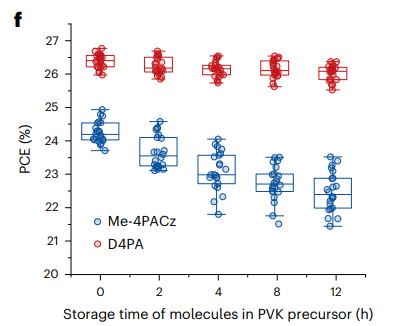
Fig. 3f
· Successful synthesis of new hole selective materialsFirstly, the core material was successfully prepared through multi-step organic synthesis reactions D4PAmolecule.
· Optimizing the precursor solution formula to achieve co depositionIn order to achieveD4PACo deposition with perovskite thin films, the research team will use a specific concentration of D4PASmall area devices are0.35 mg/mLThe mini module is0.32 mg/mL)Directly mixed into the perovskite precursor solution, forming containingD4PAPerovskite ink. This step ensures thatD4PACan be uniformly dispersed and integrated into the perovskite layer.
· Implementation of High Efficiency Small Area Device PreparationCleaning and pre-treatmentITOAfter the glass substrate, it will containD4PAThe solution of perovskite precursorSpin coating deposition methodITOOn the substrateBy controlling the spin coating speed and anti solvent drip time, a uniform perovskite film is formed, followed by thermal annealing treatment. Next, sequentially evaporate the electron transport layer(C60, BCP)And silver electrodes are used, and metal shielding is defined0.0412 cm2The device area.
· Scalability module process validationTo verifyD4PAThe research team has adjusted the perovskite precursor formula and adopted a more suitable one for large-scale production to explore its potential applications in large-scale processesScraping method(blade-coating)Will includeD4PAThe solution is coated ontoITOOn a glass substrateAfter coating, perform thermal annealing and also evaporate the subsequent electrode layer. In order to form the module, two laser engravings were also performed to define the units.
· Comprehensive evaluation of long-term stability and performanceThe prepared small area devices and mini modules are placed in a nitrogen atmosphere glove box under simulated sunlightconductedJ-VCurveEQEandMPPTWaiting for performance testingIn addition, thousands of hours of testing were conducted on the packaged devices MPPTContinuous operation stability testTo evaluate its long-term operational reliability.
Characterization methods and results
Quasi Fermi level splittingQFLS
Quantify the non radiative recombination loss in perovskite thin films and directly reflect the maximum open circuit voltage achievable within the device(VOC).QFLSThe value is based onPhotoluminescence quantum yield(PLQY) Composite saturation current density with dark radiation(J0,rad)Calculated.
D4PABasic DeviceQFLSThe value is always higher thanMe - 4PACzThe basic device further confirmsD4PAeffectiveSuppress defectsandImprove non radiative recombinationIn100 mW cm-2 Under illumination, the deviceVOCandQFLSThe difference between them is almost negligible, indicating that the interface voltage loss is extremely low.
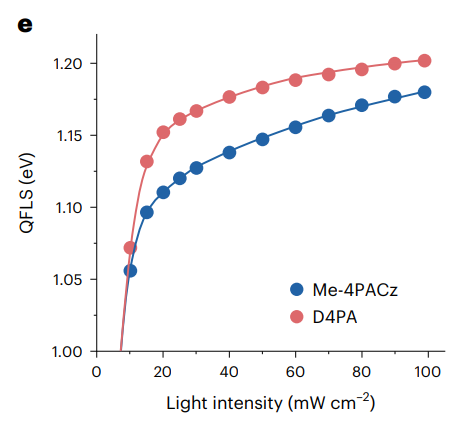
Fig. 4e:displayedMe - 4PACzandD4PAPerovskite thin films under different light intensitiesQFLSCurve.

Guangyan Technology has launched a new productQFLS-MaperPredict material performance limits!
Enlitech QFLS-MaperIn an economically affordable manner1/5The investment cost can be realizedMappingFunction and generateQFLSThe image presents a comprehensive view of the quasi Fermi level distribution, and the quality of the material is immediately apparent!
Follow us and master first-hand technical information!
current-Voltage characteristicsJ-Vcurve
Evaluate the overall photoelectric conversion performance of solar cells. useGuangyan TechnologyEnlitechXenon lamp solar simulator(SS-F5CurrentlySS-X)The calibrated light intensity is100 mW cm-2And throughKeithley 2400source tablePerform forward(-0.1 Vto1.35 V)And reverse scanning(1.35 Vto-0.1 V)Measurement. For mini modules, the scanning range is-0.1 Vto6.2 V.

l Significant improvement in performance of small area devices:D4PAbasePSCsachieved26.83%ofefficientRate (certified as26.72%)This is significantly better thanMe - 4PACzReference devices24.97%The bestD4PAdeviceopen-circuit voltage(VOC)reach, achieve, attain1.200 V(Certification value)1.197 V)Short circuit current density(JSC)for26.11 mA cm-2(Certification value)26.21 mA cm-2)Fill factor(FF)for85.63%(Certification value)85.17%).
l Module level performance validationIn terms of effective area10.86 cm2On the perovskite mini module, it has been realized PCE 23.37%And certifiedMPPTefficiency22.66%Verified itD4PAPotential in scalable processes.
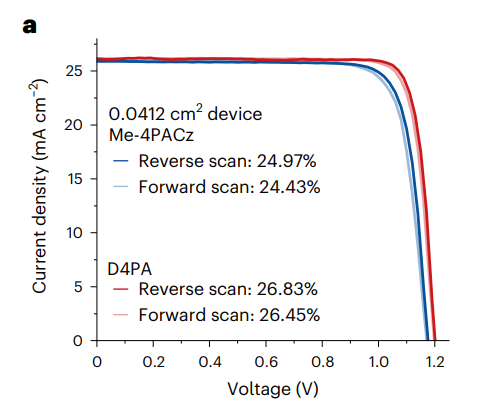
Fig. 3a:Presenting the useMe - 4PACzandD4PAasHSCThe Best Performance DeviceJ-VCurve.

Fig. 3b:displayD4PACertification of Basic DevicesJ-VCurve.
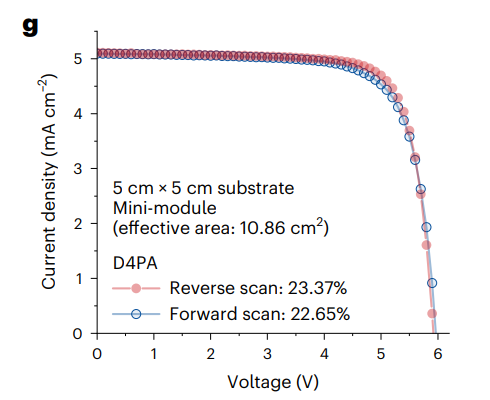
Fig. 3g:displayedD4PAThe base mini moduleJ-VCurve.
External quantum efficiencyEQE
Measuring the efficiency of solar cells in converting incident photons into electron currents at different wavelengths, which can be used to calculate the short-circuit current density of the device(JSC)In addition,high sensitivityEQE Measurement of dark radiation composite saturation current density that can be used to evaluate devices(J0,rad). UseGuangyan TechnologyEnlitechofQE-R EQEsystemConduct external quantum efficiency measurements.high sensitivityEQE Then useGuangyan TechnologyEnlitechofPECT-600system(nowFTPS)The current is amplified and modulated by a lock-in amplifier.
D4PAJi andMe - 4PACzBasic DeviceEQEThe spectrum shows similar integrated current density. high sensitivityEQEMeasurement shows that,D4PAdevice J0,radfor5.41 × 10-21mA cm-2Significantly lower thanMe - 4PACzdevice9.87 × 10-21mA cm-2This indicates thatD4PAEffectively reduces the non radiative recombination of the device.

Fig. 3e:presentedMe - 4PACzandD4PAdeviceEQESpectrum.
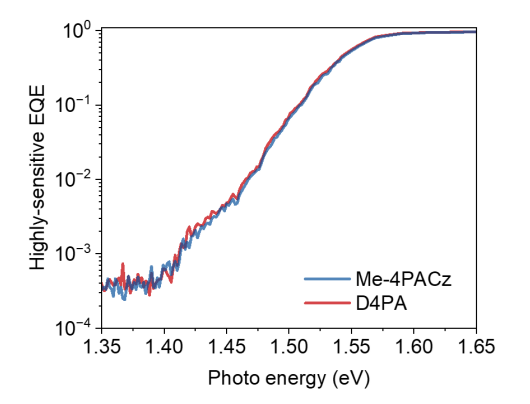
FigS. 53:displayedMe - 4PACzandD4PAbasePSCsHigh sensitivityEQECurve.
Electroluminescence quantum efficiencyEL-EQE
Directly quantifying the energy loss of devices in electroluminescent mode, highEL-EQEThe value indicates that the non radiative recombination loss of the device is relatively low. throughGuangyan TechnologyEnlitechofELCT-3010instrument(nowREPS)Apply external voltage/Measure with a current source.
D4PAbasePSCsofEL-EQEGundam 15.25%, much higher thanMe - 4PACzof6.23%This proves thatD4PAEffectively reducing the energy loss of the device.

Fig. 4f:comparedMe - 4PACzandD4PAbasePSCsIn LED modeEL-EQESpectrum.
Maximum power point trackingMPPTstability test
Evaluate packaged devices under continuous simulated solar illumination(1 The long-term operational stability of continuous operation at the maximum power point under the sun. After encapsulationPSCsIn an air atmosphere at room temperature1Equivalent to the SunLEDRunning under the light. useMulti potential difference meterTrack the output of the maximum power point and followISOS-L-1agreement.
D4PAThe base device demonstrates operational stability and operates continuously at maximum power point 2,500After hours, it can still maintain its initial efficiency97.2%aboveFar superior to the control device(2,500After an hour, only82.7%).

Fig. 3i:The packaged device is continuously displayed at the maximum power pointAM 1.5 GNormalization of simulated solar illuminationPCEEvolution.
Other characterizations
Density Functional Theory(DFTcalculate) Calculate predictionsD4PAMolecular conformation and interfacial bonding behavior, the results showD4PAThrough dual site anchoring and lower intermolecular bonding energy(-1.5 eV vs Me-4PACzof-2.356 eV)Effectively inhibit molecular aggregation.(Fig.2g)

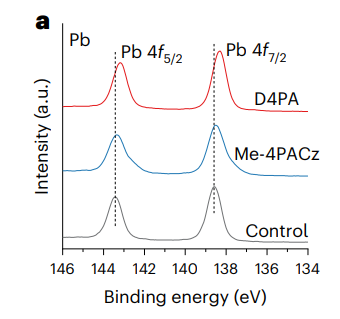
XX-ray Photoelectron Spectroscopy(XPS) Analyze the surface chemical state of the material,D4PAIn the filmPbThe significant shift of characteristic peaks confirms a stronger interfacial interaction with the perovskite layer.(Fig.2a)
Fourier transform infrared spectroscopy(FTIR) Tracking the variation of molecular vibration modes with temperature,D4PAofP=OThe vibration peak shifts and remains stable at low temperatures, indicating the formation of strong solid bonds in the early stages.(Fig.2c)

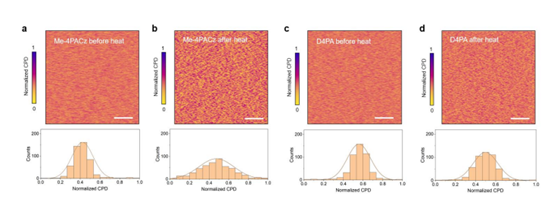
Kelvin probe force microscope(KPFM) Measure the surface potential distribution,D4PAThe film maintains a uniform and stable surface potential even after heating, confirming its correlation withITOEnhanced bonding thermal stability.(FigS.15)
Flight time secondary ion mass spectrometry(TOF-SIMS) Analyze the depth distribution of elements,P+signal displayD4PAUniformly dispersed throughout the entire perovskite layer rather than aggregated at the interface.(Fig.1b)

Dynamic Light Scattering(DLS) Monitor the molecular aggregation behavior in the solution,D4PAIn12After hours, the particle size only increased from62 nmIncrease to102 nmSignificantly lower thanMe - 4PACzof211 nmIncrease to405 nm.(Fig.2i)

Grazing incidence wide-angleXRadiation scattering andXX-ray diffraction(GIWAXS/XRD) Characterize the crystal structure of the thin film,D4PAAt lowqThe scattering intensity in the value region is significantly reduced, forming a highly disordered amorphous phase structure.(FigS.24)

Polarization related Raman spectroscopy Detecting molecular alignment orientation to further confirmD4PAThe unique structure suppresses the ordered stacking of molecules.(FigS.27)

Photoluminescence mapping and time-resolved photoluminescence(PLmapping/ TRPL) Evaluate the efficiency of charge extraction,D4PAThe film presents a more uniform low strengthPLThe significant reduction in distribution and carrier lifetime indicates an improvement in hole extraction efficiency.(Fig.4a-c)

Trap state density analysistDOSanalyze) Quantify the trap state density,D4PAThe base device is located in the deep trap region(0.4-0.5 V)Display lowertDOSConfirmed effective passivation of deep defects.(Fig.4d)

Conclusion
Research through Introductionnew-typepType small moleculeD4PAIn perovskite solar cells(PSCs)Breakthrough research achievements have been made in the field, significantly improving itsEfficiency, stability, and process feasibility.
· Unique molecular design and mechanism of action:
o D4PAis a kind ofDimerpType small molecule, its分子内C–CconjugationIn two dibenzo[c,g]Carbazole(DBC)Between units, powerfulsteric hindrance.
o This structure makesD4PAhaveRigid conformationAnd throughintramolecular hydrogen bondFurther stabilize.
o D4PAcan andITOFormation of basement and perovskite layerPowerful multi-point anchoring effectEspeciallyDual terminal(2T)Anchor configuration.
· Effectively inhibit molecular aggregation:
o D4PALow intermolecular bonding energy (approximately)**-1.495 eV**), confirming its strong spatial hindrance energyEffectively inhibit intermolecular aggregation.
o DLSTheGIWAXSandXRDAnalysis shows that,D4PAManifesting in precursor solutionLower aggregation trendAnd formHighly disordered amorphous phase structureEffectively suppressed the ordered stacking and crystallization of molecules.
o This ensuresD4PAIn perovskite inkuniformly dispersedAnd extended the precursor solutionOperating lifespan.
· Enhance interface interaction and passivate defects:
o XPSandFTIRAnalysis shows thatD4PAThere is a gap between the perovskite layer and the perovskite layerStronger interface interactionAnd formed in the early stage of grain growthStrong bonding.
o D4PAof2TAnchor configuration energyEffectively passivate deep defects on the surface of perovskite(such as iodine vacancies, iodine gaps, and iodine)/Lead inversion significantly reduces the density of trap states.
o PLImage andTRPLThe data shows that,D4PAThin filmThe efficiency of hole extraction has been improved and made more uniform.
o D4PABasic DeviceQuasi Fermi level splitting(QFLS)The value is always highFurther verification of defect suppression and non radiative composite improvement.
· device performance:
o based onD4PAThe perovskite solar cell has been realizedGundam26.83%ofefficientrate(The authentication efficiency is26.72%)Significantly surpassing the control device.
o Open circuit voltage of the best device(VOC)Reaching1.200 VShort circuit current density(JSC)For26.11 mA cm-2Fill factor(FF)For85.63%.
o Certified maximum power point tracking(MPPT)Efficiency achieved26.14%.
· Excellent long-term stability:
o After encapsulationD4PAThe base device exhibits operational stability at the maximum power point(MPP)Continuous operation2,500After hours, it still remains above97.2%The initial efficiency.
o D4PAfilm andITOThe bonding thermal stability is enhanced.
o D4PAPerovskite ink has a longer storage life,12After storing for hours,D4PAThe average efficiency of the device only slightly decreases0.32%And the reference ink device has decreased1.81%.
· Feasibility of implementing large-scale processes:
o This study is conducted throughScraping methodSuccessfully manufactured an effective area of10.86 cm2The perovskite mini module, itsEfficiency achieved23.37%(certificationMPPTEfficiency is22.66%).
This achievement demonstratesD4PAInSimplify commercial continuous processesThe enormous potential in high-efficiency and scalable perovskite solar cells.
Reference from Nature photonics_DOI: 10.1038/s41566-025-01725-x
This article is rewritten by Enlitech for scientific research and academic sharing. If there is any infringement, please inform us by email