-
E-mail
qeservice@enli.com.tw
-
Phone
18512186724
-
Address
Room 409, Building A, No. 169 Shengxia Road, Pudong New Area, Shanghai
About Us
Guangyan Technology Co., Ltd
Date: 2025-08-28Read: 1
Research background and challenges
perovskite-Organic cascaded solar cells(POTSCs)With its adjustable energy band advantage, theoretically it has the potential to break through single junction batteriesShockley-QueisserThe ultimate potential. Compared to other cascading techniques,POTSCsAdvantages: The UV filtering properties of the perovskite layer enhance operational stability, the full film structure supports high-yield roll to roll processes, and can be processed on flexible substrates in conventional environments, making it particularly suitable for applications such as building integration, vehicle integration, and portable electronic products.
However,POTSCsDevelopment faces key technological bottlenecks:Currently certified efficiency(24.7%)Still lower than the fully perovskite cascade battery(28.2%)And perovskite-CIGSCascaded battery(24.2%)The core issue causing this efficiency gap isInsufficient near-infrared light current in narrow bandgap organic bottom batteriesThe main reasons include:
Lack of suitable materialsCurrently, there is a lack of high-efficiency narrow bandgap non fullerene receptors(NFAs). existingY6Optical energy gap of the receptor(~1.33 eV)Ideal energy gap for cascade configuration(~1.00 eV)It still belongs to secondary optimization.
Difficulty of energy level matchingTraditional ReductionNFAThe strategy of bandgap, such as extending the conjugated length and enhancing intramolecular charge transfer, often leads toHOMOExcessive increase in energy level leads to energy level mismatch with polymer donors, which in turn affects exciton dissociation efficiency and limits the performance of open circuit voltage and fill factor.
Research team and core achievements
Research byHou Yi from the Department of Chemical and Biomolecular Engineering at the National University of Singapore and the Solar Energy Research Institute of Singapore(Yi Hou)教授Leadership, research results published in top journals《Nature》.
The research team focuses onPOTSCsTwo key innovative strategies are proposed to address the core efficiency bottleneck:
Strategy 1: Improve the performance of narrow bandgap organic bottom batteries Team designs and synthesizes novel asymmetric non fullerene receptorsP2EH-1V, using unilateral conjugationπBridge strategy reduces the optical energy gap to1.27 eVSimultaneously maintaining ideal exciton dissociation and nanoscale morphology. Confirmation through femtosecond transient absorption spectroscopyPM6toP2EH-1VEfficient hole transfer and display of non radiative voltage loss using electroluminescence quantum efficiency measurement0.26 eVSignificantly reduced to0.20 eV.
Strategy 2: Optimize the interface of wide bandgap perovskite solar cells Developing new self-assembled monolayersBr-Ph-4PACzBy effectively regulating the work function through bromophenyl substituentsHOMOEnergy level, improve band alignment with perovskite and reduce interface recombination losses. Using ultraviolet photoelectron spectroscopy and Kelvin probe force microscopy to evaluate energy level alignment, and confirming non radiative recombination reduction and intrinsic voltage increase through steady-state photoluminescence and quasi Fermi level splitting measurements.
Breakthrough achievementsCombining the above innovative strategies,POTSCsEfficiency achieved26.7%, independently certified by the Shanghai Institute of Microsystems and Information Technology as26.4%Create more than1 cm2Surface Area Devicesworld record.
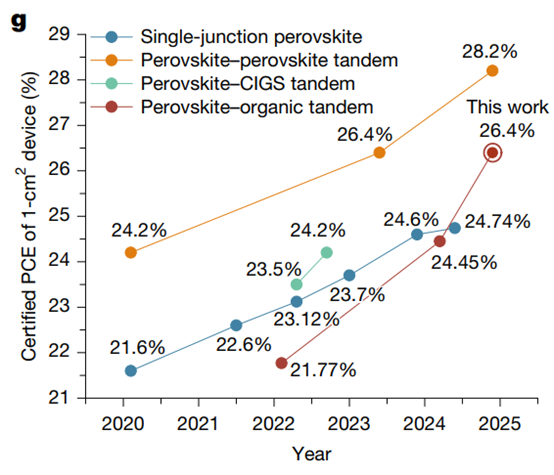
Fig. 4g
Experimental steps and device preparation

Fig.4a
This study mainly employs two core strategies,Design and prepareDevelop high-performance key components for solar cells, ultimatelyintegrationRecord breaking perovskite-Organic cascaded solar cells. The following are the main experimental steps and processes:
Research core strategyThis study mainly conducts experiments around two core bottlenecks: one is to improveNarrow bandgap organic bottom batteryThe photoelectric current, the second is to solveWide bandgap perovskite based batteryThe problem of voltage and fill factor loss.
Innovative Materials and Preparation of Narrow bandgap Organic Bottom Batteries
New asymmetric non fullerene receptor(NFA) P2EH-1VThe successful synthesis
research teamDesign and successfully synthesizeA new type ofAsymmetric non fullerene receptorP2EH-1V.
This material passes throughUnilateral conjugateπBridge Strategy, achieving the reduction of optical bandgap to1.27 eV.
Assembly of high-efficiency organic bottom battery unit devices
Single junction organic solar cells adoptITO/MoOx/PM6:NFA/PDINN/AgPrepare the structure.
among which,PM6As a donorTheP2EH-1VAs a receptorBoth of them 1:1.2The proportion of mixingIn chloroform solution, the total concentration is16 mg/ml.
Spin coat the mixed solution ontoMoOxOn the layer, followed by thermal annealing treatment, and finally depositedPDINNandAgThe electrode has been prepared.
Interface optimization and preparation of wide bandgap perovskite based batteries
New type of self-assembled monolayer(SAM) Br-Ph-4PACzDevelopment of
research teamDevelop and synthesizeA new type ofSelf-assembled monolayerBr-Ph-4PACz.
This material is introduced throughBromophenyl substituentIntended to effectively regulate the work function andHOMOEnergy levels are used to improve band alignment with perovskite.
Preparation of high-performance perovskite based battery cell devices
Single junction wide bandgap perovskite solar cells adoptITO/SAM/perovskite/C60/BCP/AgPrepare the structure.
Firstly, the SAM (Br-Ph-4PACz)solutionSpin coated patternedITOHeat on a glass substrate.
Subsequently, it willPerovskite precursor solution with specific composition(Cs0.25FA0.75 Pb(Br0.4I0.6)3) Spin coatingSAMOn top of the layer, annealing is carried out to form a perovskite thin film.
Finally, deposit in sequenceEDAI2solutionC60TheBCPandAgElectrodes are used to complete the device.
High efficiency perovskite-Integration of Organic Cascade Solar Cells
Optimize the structure of cascaded devices and interconnect layer design
The final perovskite-Organic cascaded solar cells adoptglass/ITO/SAM/perovskite/ C 60 / SnOx / ITO / MoOx /organic/PDINN/AgThe complete device architecture.
Key interconnect layersLocated between the perovskite based battery and the organic based batteryC60Atomic layer deposition(ALD)ofSnOxSputteredITOAnd thermal evaporationMoOx Composition to ensure efficient charge transfer.
The upper and lower batteriesAbsorption layer thicknessAfter precise optimization (perovskite approximately)290 nmThe organic layer is approximately110 nm)To achieve a balance of current density between the two sub batteries.
Characterization methods and results
Quasi Fermi level splitting(Quasi-Fermi Level Splitting, QFLS)
evaluateSAMThe voltage loss at the interface with perovskite and the non radiative composite suppression effect,QFLSImprove direct reflection devicesVOCImprovement potential.
Obtained through strength dependent open circuit voltage measurementQFLSAnalysis shows that,Br-Ph-4PACzThe processed perovskite film exhibits significant interface optimization effects.Br-Ph-4PACz/Quasi open circuit voltage of perovskite stack(iVoc)reach, achieve, attain1.38 VSignificantly higher thanMe-4PACzThe perovskite stack1.34 VThe improvement is significant40 mVThis result confirms thatBr-Ph-4PACzBy regulating the work function of bromophenyl substituents, it effectively reducesSAMEnergy level mismatch with perovskite interface, reducing interface recombination loss for devicesVOCEnhance the provision of direct driving force.

image3dShowcasing single junction wide bandgap perovskite solar cells in two typesSAMProcessed underVOCComparative analysis of losses.Br-Ph-4PACzThe sample shows higherQFLSValue and lower interface voltage loss, visually presenting bromophenyl functionalizationSAMSignificant advantages in interface engineering optimization.
Latest Release from Guangyan TechnologyQFLS-MaperAnalyze the upper limit of material potential!
Enlitech QFLS-Maperlet youwithCompetitive1/5cost advantageYou can obtain itQFLS MappingandQFLSimagingClearly display the spatial distribution of quasi Fermi levels, making the quality of materials clear at a glance!
Track our updates and obtain them as soon as possibleTechnical information!
current-voltage(J-V)Curve measurement
Evaluating the photoelectric conversion performance of single junction and cascaded devices directly reflects the comprehensive effect of material innovation and device engineering optimization.
Simulate in a nitrogen filled glove box1sun AM 1.5Gillumination(100 mW cm-2)Measure devices of different areas(0.050 cm2and1.019 cm2)Performance.
l PM6:P2EH-1VOrganic solar cellsimplement17.9% PCEBreakthrough, showcase0.82 VOpen circuit voltage28.60 mA cm-2High short-circuit current density and76.5%Fill factor.
l Br-Ph-4PACzPerovskite solar cellsachieve20.4% PCE, possessing1.37 VUltra high open circuit voltage and85.5%Excellent filling factor.
l perovskite-Organic cascaded solar cellsAchieve record breaking results26.7% PCE(VOC: 2.14 V, JSC: 15.15 mA cm-2, FF: 82.4%)Large area devices(1.019 cm2)Similarly maintain26.7% PCE.
The independent certification result of Shanghai Institute of Microsystems and Information Technology is26.4% PCEThe positive and negative scans are consistent and there is no obvious hysteresis phenomenon. It has been certified as centimeter level single junction perovskite and perovskite-CIGSAnd perovskite-Organic cascaded batteriesPCErecord.

image4bShowcasing single junction organic batteries, perovskite batteries, and tandem batteriesJ-VCombining curves, clearly comparing the optoelectronic parameters of three devices, and visually presenting the significant advantages of the cascaded architecture in optimizing voltage addition and current matching.

image4eExhibition of ClassicsSIMITcertified1 cm2Cascaded batteryJ-VCurve, positive and negative scanningPCEall26.4%Confirm the performance and stability of the device in practical applications.
External quantum efficiency(External Quantum Efficiency, EQE)measurement
Evaluate the spectral response and current matching degree of each sub cell, and verify the synergistic effect and current balance of the upper and lower sub cells in the cascaded battery.
PM6:P2EH-1VOrganic bottom batterybecauseP2EH-1VThe redshift absorption characteristics of materials,EQEIntegral current density reaches27.86 mA cm-2, withJ-VThe test results are highly consistent(error<3%).perovskite-Organic cascaded batteryPerovskite based cells and organic bottom cellsEQEpointsJSCrespectively15.20 mA cm-2and15.14 mA cm-2This indicates that the current density between the two sub batteries has reached a good match, which is the key to achieving high-efficiency cascaded batteries.

image4dperovskite-Perovskite and organic sub cells in organic cascade batteriesEQECurves and integralsJsc, displays the two sub cells in the cascaded batteryEQEThe curves clearly demonstrate their absorption contributions to light of different wavelengths, as well as the current density reaching equilibrium after integration
Electroluminescence quantum efficiency(Electroluminescence Quantum Efficiency, EQEEL)measurement
Evaluate the non radiative energy loss and recombination mechanism of organic solar cells, usingEnlitech ELCT-3010(REPS)systemApply external voltage to the device/Measure with a current source.

P2EH-1VInnovative receptor materials demonstrate non radiative composite inhibitory effects, andP2EHCompared to benchmark devices,P2EH-1VReduce the total energy loss of the device0.05 eVMainly due to a significant reduction in non radiative energy loss, from0.26 eVSignificantly improved to0.20 eVThis result confirms thatP2EH-1VBy optimizing the molecular structure design, the density of defect states and non radiative recombination pathways are effectively reduced.

image2fdisplayPM6:P2EHThePM6:P2EH-1VandPM6:P2EH-2VSummary of energy loss analysis of organic solar cells, clear comparison of non radiative energy loss of different receptor materials(ΔEnon-rad)Distribution, intuitive presentationP2EH-1VSignificant advantages in suppressing non radiative recombination.
sensitive typeEQE/Fourier transform photocurrent spectrometer(Sensitive EQE/FTPS)
Evaluate the detailed energy loss mechanism of organic solar cells usingEnlitech PECT-600(FTPS)systemRecord sensitive typeEQECombined with electroluminescence(EL)Curve progressionGaussianFitting analysis.

FTPS-EQEandELConfirmation of the precise fitting results of the curve once againP2EH-1VThe performance of the device in suppressing non radiative energy loss. The degree of curve alignment directly reflects the balance between the radiative and non radiative recombination processes of the device,P2EH-1VThe material achieves a dual effect of radiation composite enhancement and non radiation loss reduction through optimized electronic structure design.

image2hdisplayPM6:P2EH-1VThe mixing deviceFTPS-EQECompared to the electroluminescence curveGaussianThe fitting comparison visually confirms the high consistency and precise alignment of the two curvesP2EH-1VThe effectiveness in reducing non radiative energy loss.
Other characterizations
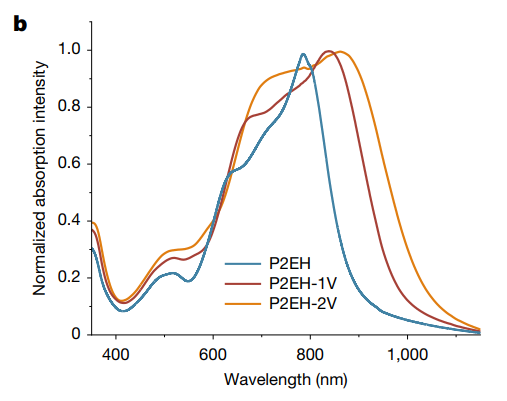
ultraviolet-Visible spectrum(UV-Vis)Characterize the light absorption characteristics of materials and evaluate the effect of bandgap regulation.P2EH-1VSignificant red shift in absorption80 nmThe optical bandgap is reduced to1.27 eVExpand the near-infrared light absorption range.(image1b)
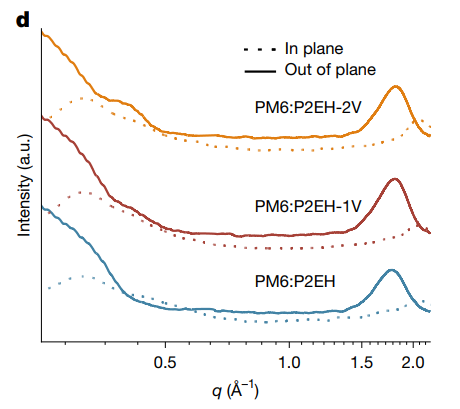
Grazing incidence wide-angleXRay scattering(GIWAXS)Characterize the crystal behavior and molecular stacking orientation of thin films, and evaluate charge transfer pathways. allNFAAll show a preferred face orientation,PM6:P2EH-1VThe blend film maintains good and orderly stacking.(image1d)
atomic force microscope(AFM)Evaluate the surface morphology and roughness of the film to reflect its quality.Br-Ph-4PACzThe surface of perovskite film is more uniform, and the roughness is reduced to18.9 nm, superior toMe - 4PACzof22.2 nm.(FigS. 27)

Ultraviolet photoelectron spectroscopy(UPS)Evaluate the alignment of material interface work function and energy level, and optimize interface charge transfer.Br-Ph-4PACzThere is a deeper work function and more favorable band alignment, reducing interface energy loss.(image3b)

Kelvin probe force microscope(KPFM): QuantificationSAMFunction control effect, verify interface engineering optimization.KPFMImage confirmationBr-Ph-4PACzCan regulate more effectivelyITODistribution of substrate work function.(FigS. 18)

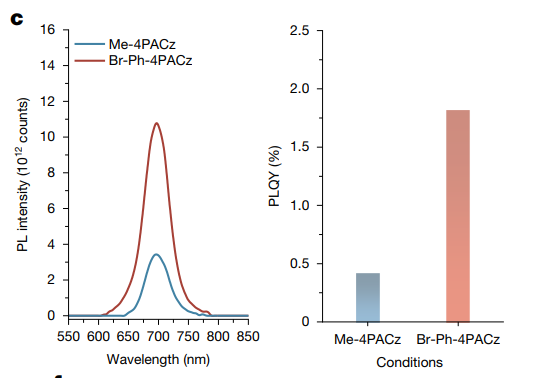
Photoluminescence spectrum(PL)And confocal microscopyPLmappingEvaluate non radiative recombination loss and film uniformity, reflecting defect passivation effect.Br-Ph-4PACzperovskite thin filmPLIncreased intensity by five times,PLQYfrom0.41%Significantly increased1.82%.(image3c)
Transient absorption spectroscopy(TA)Evaluate charge dynamics and hole transfer processes to verify exciton dissociation efficiency.575 nmApply the bodyGSBDynamics verificationP2EH-1Vto, toward, at, facingPM6Efficient hole transfer.(image2d)

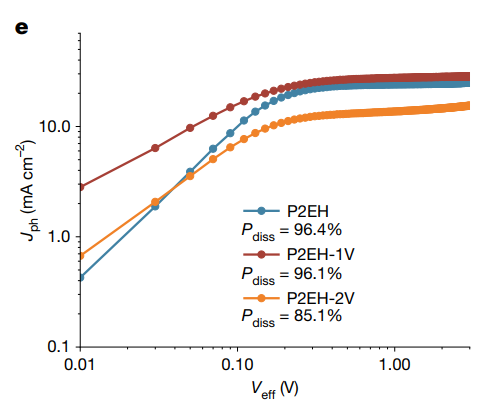
Probability of charge dissociation(Pdiss)analyzeEvaluate the efficiency of photo generated exciton charge generation and quantify exciton dissociation ability.PM6:P2EH-1VdevicePdissreach96.1%Show the probability of charge generation.(image2e)
Impedance spectrum(Impedance)Study the charge recombination resistance of devices and evaluate the carrier transport characteristics.NyquistImage displayP2EH-1VThe device has higher composite resistance and lower charge recombination loss.(FigS. 14)

Transient photocurrent(TPC)measurementMeasure the charge carrier extraction lifetime and evaluate the charge collection efficiency.Br-Ph-4PACzDevice photocurrent attenuation life shortened to0.73 μsImproved carrier extraction efficiency.(image3f)

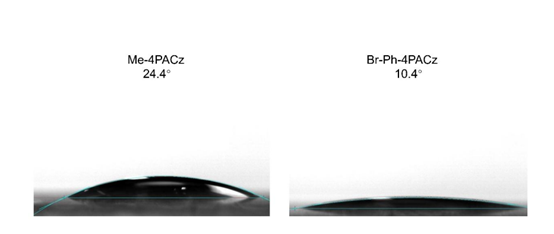
Contact angle measurement:研究SAMWetting characteristics, evaluate the uniformity of film coverage.Br-Ph-4PACzThe contact angle of the substrate has decreased to10.4°Improve the wettability and film coverage of perovskite precursors.(FigS. 22)
Long term maximum power point(MPP)stability assessmentEvaluate the long-term operational stability of the device and verify its practical potential. Encapsulated cascaded battery783Maintain after hours80%Efficiency,Br-Ph-4PACzdeviceT80extend to550Hour.(image4h)

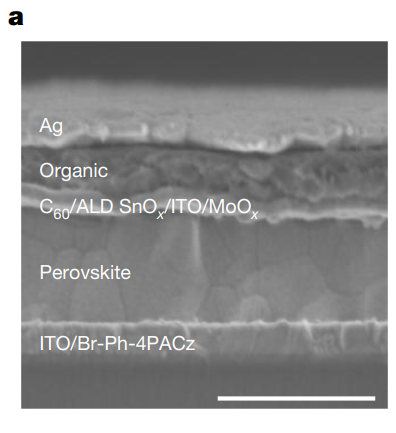
Cross-sectional scanning electron microscope(SEM)Visualize the structure of cascaded devices and the thickness of each layer to verify the accuracy of preparation. Clear display of optimized perovskite(~290 nm)With Organic(~110 nm)Absorption layer and multi-layer interconnect structure.(image4a)
Conclusion
The research team is working on perovskite-Breakthrough progress has been achieved in the field of organic cascaded solar cells, successfully achieving record breaking efficiency and stability through a dual innovation strategy.
Core technology breakthrough
Innovative Material DesignDeveloping novel asymmetric non fullerene receptorsP2EH-1V, through a unidirectional ethylene double bondπBridge strategy reduces the optical energy gap to1.27 eV, absorption spectrum redshift of about80 nmAchieve high28.60 mA cm-2The short-circuit current density. Organic bottom battery efficiency reaches17.9%Non radiative composite losses from0.26 eVdrop to0.20 eVThe probability of charge dissociation is as high as96.1%.
Interface engineering optimizationDesign self-assembled monolayersBr-Ph-4PACzBy regulating the work function and band alignment through bromobenzene substituents, perovskite thin films can be formedPLIncreased intensity by five times,PLQYfrom0.41%Significantly increased1.82%The efficiency of wide bandgap perovskite solar cells reaches20.4%, possessing1.37 VHigh open circuit voltage and85.5%Fill factor.
performance
Record breaking efficiency: Perovskite-Implementation of organic cascaded solar cells26.7% PCE, independently certified by the Shanghai Institute of Microsystems and Information Technology as26.4%,Exceeding all publicly reported single junction perovskites and perovskites-Perovskite cascade and perovskite-CIGSSerial battery recordFor 1 A centimeter square effective area device with stable power conversion efficiency(PCE)Achievable26.5%
Excellent stabilityEncapsulated cascaded batteries under environmental conditions(25°C, 85%relative humidity)sutra783hourMPPKeep track after tracking80%Initial efficiency, significantly better than single junction organic batteries(T80only180hour).Br-Ph-4PACzdeviceT80extend to550At the hour, it was confirmed that the ultraviolet filtering effect of the perovskite layer has a positive effect on long-term stability.
Reference from Nature_DOI: 10.1038/s41586-025-09181-x
This article is rewritten by Enlitech for scientific research and academic sharing. If there is any infringement, please inform us by email