-
E-mail
info@phenom-china.com
-
Phone
18516656178
-
Address
Room T5705, Shanghai Hongqiao Libao Plaza, No. 88 Shenbin Road, Hongqiao Town, Minhang District, Shanghai
Funa Scientific Instruments (Shanghai) Co., Ltd
Liu Yanhui's team releases amorphous alloy digital intelligence platform: automatic scanning electron microscopy - a new paradigm for material research and development
Date: 2025-11-28Read: 0

With the increasing demand for material properties from high-end equipment and cutting-edge technology, the complexity of alloy materials in terms of element types, composition span, microstructure, and other aspects continues to increase. Amorphous alloys are typical complex alloy systems that exhibit molding characteristics and mechanical, physical, and chemical properties that are not present in other alloys. They play an important role in critical fields. Then, the composition space covered by amorphous alloys is huge, and the preparation process depends on environmental atmosphere, high temperature, cooling rate and other conditions, making material research and development extremely difficult.
Material genetic engineering can simultaneously enhance the breadth and speed of material exploration. The Liu Yanhui team, in collaboration with relevant industry enterprises, has built an amorphous alloy digital intelligence research and development platform after nearly two years of technological breakthroughs. This platform deeply integrates the concept of material genetic engineering, artificial intelligence methods, and automatic experimental technology, providing a new mode of "data-driven intelligent design automatic experiment material discovery" for amorphous alloy research and new material exploration (as shown in the figure below). In terms of intelligent design, the team developed GlassChat, an intelligent assistant that can recommend new alloys, based on a professional database of amorphous alloys and field literature, combined with a big language model.

▌ [Highlights of amorphous alloy intelligent research and development platform] AI+material genetic engineering+automated experiments
In the automated experimental phase, the team has achieved a series of technological breakthroughs, and these systems operate in a coordinated manner, enabling a closed-loop system for intelligent design, high-throughput preparation, automatic characterization, and data feedback throughout the entire process. During the platform construction process, 3 invention patents have been applied for and 1 invention patent has been granted. These technologies cover the core processes of batching, preparation, and characterization, and will significantly improve the efficiency and accuracy of amorphous alloy research and development. This platform realizes intelligent and automated deployment of the entire process from material design to experimental verification:
1. Intelligent alloy recommendation system GlassChat
Based on the professional database of amorphous alloys and large model algorithms, it is possible to provide composition recommendations and feasibility assessments for unknown systems, making material exploration no longer "blind"
2. Automatic batching and melting system
Realize precise weighing of raw materials and full process monitoring, ensure stable and consistent processes, and provide guarantees for reliable data accumulation.
3. High throughput preparation and testing system for composite thin films
Significantly improve material validation speed and assist in precise screening in a vast composition space.
These systems have achieved a true closed-loop system of intelligent design, automatic preparation, automatic characterization, and data feedback through data-driven and feedback iteration.
Feina Desktop Large Warehouse Automated Electron Microscope - The Core Strength of Automatic Characterization
In the automatic characterization stage, the team collaborated with the Feina electron microscope as a key technical component for automatic characterization. The system can complete the entire process from navigation, imaging to analysis with minimal human intervention. Researchers only need to set detection tasks to achieve highly consistent and repeatable automated data collection, making high-throughput characterization of massive samples a reality. Significantly improve efficiency, truly achieve Free to Achieve, and make scanning electron microscopy more intelligent.
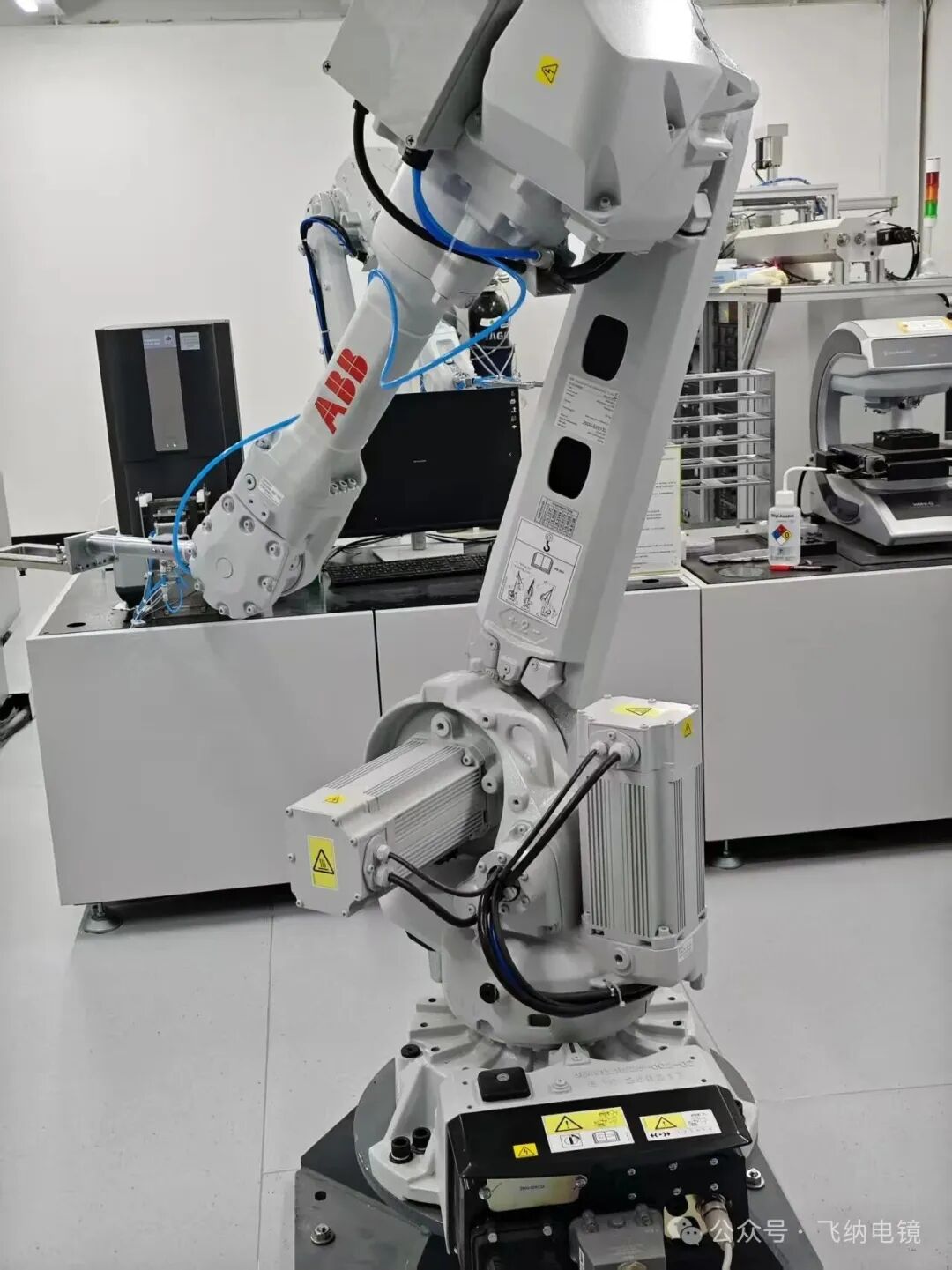
The robotic arm can accurately place the sample into the sample chamber, and then, according to the set program, the scanning electron microscope will automatically close the door and start automatic sampling. During this process, it will accurately and automatically adjust the focal length, magnification, etc. according to preset parameters, ensuring that every photo is clear and accurate. After the shooting is completed, the data will be automatically uploaded to the designated platform for researchers to view and analyze at any time. In addition, the system also supports automatic spectral analysis to accurately detect sample components.
✓Automated sample loading by robotic armNo need for manual intervention, high consistency standard operation
✓Full process automatic imaging and parameter adjustmentIncluding autofocus, brightness contrast optimization, and batch imaging recording
✓Adaptability to high stability environmentsBreaking free from the expensive installation conditions of traditional electron microscopes, the office area can also operate stably
✓Digitized data feedbackDirectly serving machine learning model optimization, helping the knowledge base to continuously grow
Automated characterization has become possible through collaboration with Feina electron microscopy technology. The establishment of automated data collection and intelligent data links has significantly improved the efficiency, consistency, and reliability of material development processes, providing robust support for high-throughput research.
From 'trial and error' to 'precise iteration'
At present, the platform has applied for multiple inventionsSpecialized in LiAnd possess the ability to expand horizontally:
A wider range of material systems including copper, aluminum, titanium, and high entropy alloys
National key industries such as aerospace, power electronics, and biomedicine
The direction of national material digitization strategy is fully aligned
This achievement fully demonstrates the strength of the Chinese research team in the field of material genetic engineering, as well as the unlimited extension value of the digital material research and development platform in the future. Feina will continue to deeply participate in the process of scientific research intelligence through technological collaboration, and contribute to the construction of the national strategic new material system. Feina Electron Microscopy empowers material innovation with intelligence, enabling every future material to reach the future faster.
Last Article: The Function and Application of Nanoparticle Generator
Next Article: How to choose a nanoparticle generator?