-
E-mail
ethan@lab-tester.com
-
Phone
13926824844
-
Address
Room 601, Building 2, R&D Building, Lihe Zijing Science and Technology Innovation Center, No. 55 Qinghu East Road, Qingxi Town, Dongguan City, Guangdong Province
Dongguan Hongtu Instrument Co., Ltd
Motorcycle Helmet ECE R22.06 Slope Impact Test: The Core Value of Acceleration and Angular Velocity Collection
Date: 2025-11-29Read: 0
1、 ECE R22.06 Standard: The 'Golden Rule' for Motorcycle Helmet Safety Testing
Why is the ECE R22.06 standard crucial?
As the "life line of defense" for riders, the safety performance of motorcycle helmets is directly related to the safety of drivers and passengers. ECE R22.06 was jointly developed by the Guo Economic Commission for EuropeMotorcycle Helmet Safety Certification StandardCompared to the old version of the standard, it has stricter requirements for the impact resistance, protection range, and wearing stability of helmets, and has become the core basis for market access of motorcycle helmets in China.
1.2 Slope Impact Test: Simulating Key Scenarios of Real Accidents
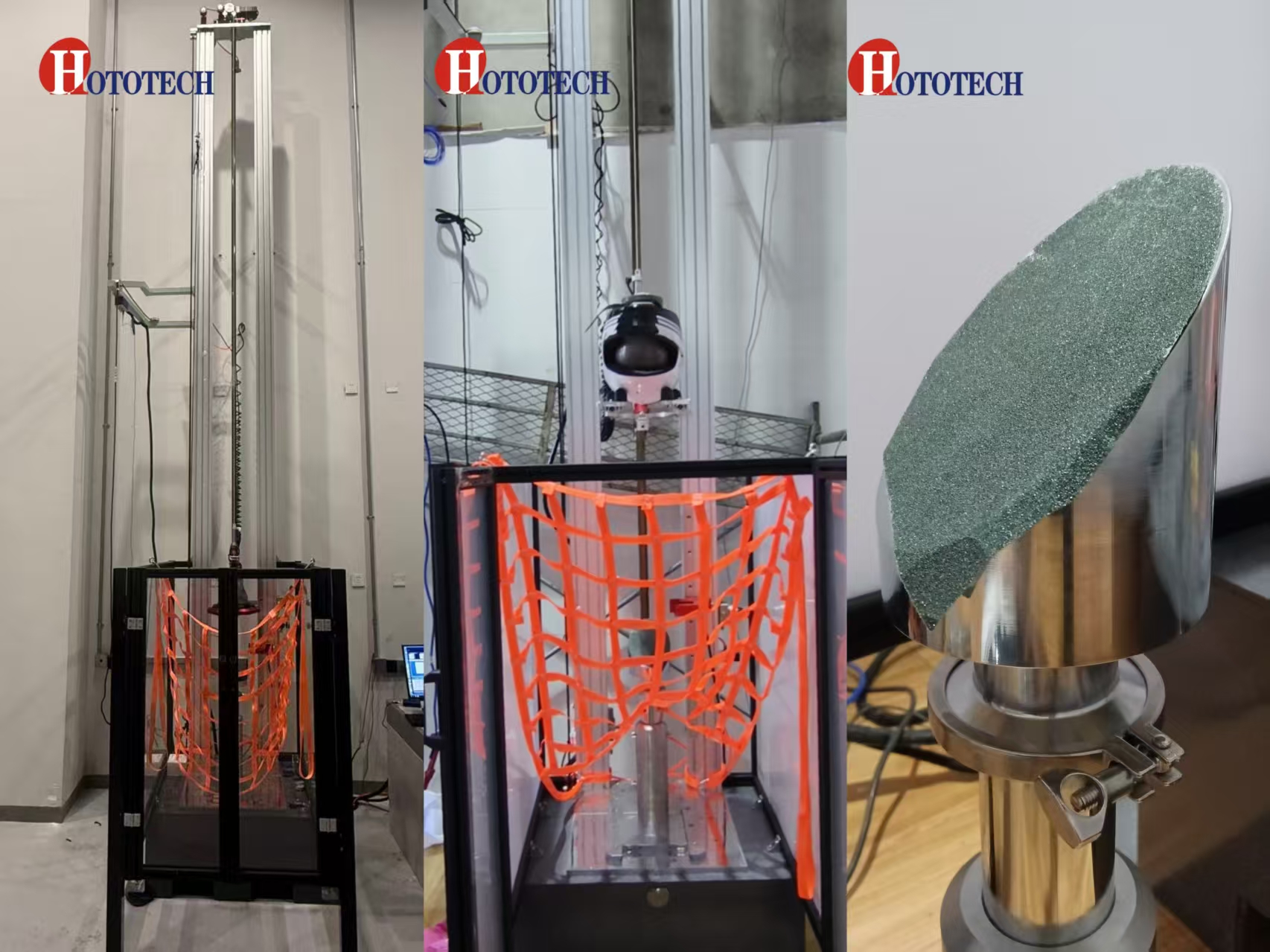
In multiple tests of the ECE R22.06 standard,Slope impact testIt is one of the core projects that is closest to real accidents. This test simulates the scenario of a motorcycle rider's head colliding with a tilted hard object (such as a road surface or guardrail edge), focusing on assessing the helmet's energy absorption ability, anti penetration performance, and protective effect on the wearer's head under non vertical impacts - all of which cannot be separatedAccurate collection of acceleration and angular velocity data.
2、 Acceleration and angular velocity acquisition: the "data core" of testing
2.1 Core objective of collection: Quantify the force state of the head
The ultimate mission of motorcycle helmets is to reduce the risk of head injury during collisions, while the headacceleration(Reflecting the force of linear impact) andangular velocity(Reflecting the strength of rotational impact) is a key indicator for assessing the risk of injury. By collecting these two pieces of data, the magnitude and trend of force on the head during the collision can be directly quantified, and it can be determined whether the helmet can effectively cushion the impact and reduce the probability of brain injury.
Why are these two pieces of data indispensable?
Acceleration acquisitionFocus on the linear impact of the head (such as the "hard hitting" impact force during collision). According to biomechanical research, when the head acceleration exceeds a specific threshold (such as 250g), the risk of concussion, intracranial hemorrhage, and other conditions will sharply increase. Collecting acceleration data can directly verify the helmet's performanceEnergy absorption performanceDetermine whether its buffering structure meets the standard.
Angular velocity acquisitionPay attention to the rotational impact on the head (such as the torsional force when impacted by a sloping surface). In real accidents, the head often undergoes rotational motion, and the shear force generated by this rotation can cause serious damage to brain tissue. The ECE R22.06 standard explicitly requires controlling the angular velocity of the head, and collecting data can verify the helmet's performanceAnti rotation designWhether the anti slip structure of the lining and the optimization of the shell shape are effective.
3、 The purpose of collecting products: from testing to product optimization
3.1 Testing phase: Ensure that the product meets the standard admission requirements
Professional acceleration and angular velocity acquisition devices (such as built-in sensors and data recorders) are important tools for ECE R22.06 slope impact testing. During the testing process, the device will collect real-time dynamic data of the collision moment, generate accurate waveform diagrams and statistical reports:
If the data does not exceed the standard threshold (such as acceleration ≤ 250g, angular velocity ≤ 5000 rad/s), the helmet passes the test.
If the data exceeds the standard, targeted optimization of helmet design (such as adjusting the density of cushioning materials and optimizing the shell structure) is required until the test meets the standard.
3.2 R&D stage: Drive product safety performance upgrade
The value of collecting products lies not only in "passing tests", but also in providing data support for helmet development. By analyzing the collected data of different design schemes, the R&D team can accurately locate the optimization direction:
For example, if the acceleration data of a certain helmet is too high, it can be improved by increasing the thickness of the buffer layer and replacing high-performance energy absorbing materials;
If the angular velocity data does not meet the standard, the fit of the helmet lining can be optimized, and anti rotation buckles can be designed to reduce the twisting of the head during collisions.
3.3 Market Stage: Conveying Safety Confidence to Consumers
Helmets certified by ECE R22.06 can use acceleration and angular velocity data as core safety endorsements. Enterprises can highlight 'economy' in product promotionXXTesting shows that the head acceleration/angular velocity meets the ECE R22.06 standard, allowing consumers to intuitively perceive the safety performance of the product and enhance purchasing trust.
4、 The core requirements of the collection device are precision, stability, and impact resistance
4.1 Key characteristics that meet testing requirements
To ensure the effectiveness of data collection, ECE R22.06 testing has strict requirements for the collection equipment:
High sampling rateTo achieve a frequency of over 1000Hz and capture dynamic data changes at the moment of collision (in milliseconds);
impact resistanceCapable of withstanding severe impacts during collisions (≥ 500g), ensuring that the equipment itself is not damaged and data is not lost;
data accuracyThe error should be controlled within ± 2% to ensure the credibility of the test results;
miniaturized designThe sensor should be compact and lightweight to avoid affecting the helmet wearing state and collision force distribution.
4.2 Mainstream Collection Solution: Built in Sensor+Wireless Transmission
The current mainstream collection solution in the industry is "built-in three-axis acceleration sensor+three-axis angular velocity sensor", used in conjunction with wireless data recorders:
A simulated head model with sensors embedded inside the helmet (EN 960 standard head shape) that fits the real wearing scene;
The collision data is wirelessly transmitted to the computer terminal, generating real-time analysis reports for testing personnel to quickly determine the results.
5、 Summary: Data collection is a secure 'invisible guardian'
The acceleration and angular velocity collection in the slope impact test of motorcycle helmet ECE R22.06 is not only a "mandatory requirement" for standard certification, but also a "core link" to ensure the safety of riders' lives. Professional collection products not only help enterprises achieve product compliance and access, but also promote the continuous upgrading of helmet safety technology by accurately capturing key data - ultimately enabling every motorcycle rider to enjoy riding pleasure under safe protection.
Choosing a helmet that meets the ECE R22.06 standard is essentially choosing a safety guarantee that has been validated by scientific data. And behind this is the silent protection of acceleration and angular velocity acquisition technology.