-
E-mail
1471815660@QQ.COM
-
Phone
18925778253
-
Address
No. 29, Houjie Section, Port Avenue, Houjie Town, Dongguan City, Guangdong Province
Dongguan Baopin Precision Instrument Co., Ltd
The structural composition and function of twin-screw extrusion granulator
Date: 2025-12-14Read: 2
Twin screw extrusion granulator is one of the widely used equipment in modern plastic, rubber, and chemical industries. It utilizes the collaborative work of two screws to achieve processes such as material mixing, extrusion, and granulation. Compared with single screw extruders, twin-screw extruders have stronger mixing properties, higher production efficiency, and better controllability, and are widely used in fields such as plastic granulation, rubber processing, and food industry.
Twin screw extrusion granulatorThe core components are two screws that rotate relative to each other. There is a certain gap between the screws, and the shape and arrangement of the threads can be customized according to different processing requirements. During the working process, materials enter the barrel from the feeding port and undergo mechanical shearing, compression, mixing, heating, and other treatments between the screws through the rotational motion of the screws. Finally, they are extruded into particles of the desired shape.
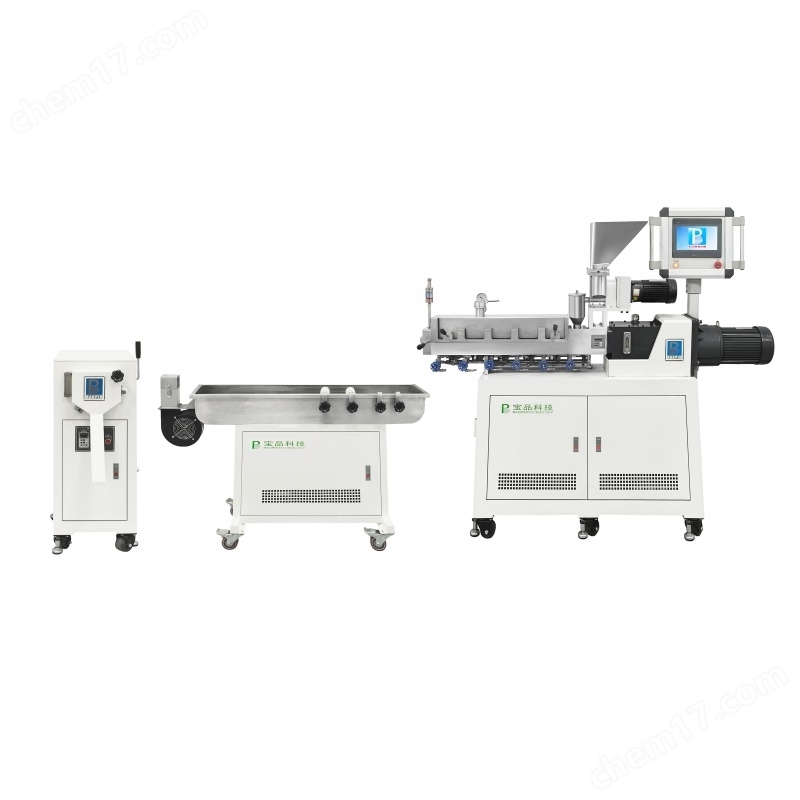
The two screws of a twin-screw extruder can be parallel or staggered. Parallel twin-screw extruders are commonly used for processing ordinary plastics and rubber due to their simple structure and stable production, while staggered twin-screw extruders are commonly used for processing complex materials or polymer materials due to their strong mixing performance. During the working process, parameters such as screw speed, heating temperature, and pressure can be adjusted as needed to achieve precise control over the material processing.
Structural characteristics:
1. Twin screw structure
The biggest feature of a twin-screw extruder is the use of two interacting screws. The design of the screw directly affects the processing performance of the equipment. There are two common types of screw structures: opposite direction (reverse rotation) and same direction (forward rotation). The opposite direction type is suitable for mixing materials with high performance requirements, while the same direction type is commonly used for extruding single materials.
2. Feeding system
The feeding system is an important component of twin-screw extruders, usually including screw feeding, gravity feeding, heating feeding, etc. The material enters the extruder through the feeding system and is fed into the screw area. In the feeding system, ensuring uniform feeding and flowability of materials is the key to ensuring production efficiency and product quality.
3. Barrel and cooling system
The barrel of a twin-screw extruder is usually composed of multiple heating and cooling sections, which control the temperature distribution of the material in the screw. The heating zone is used to provide an appropriate temperature to melt or plasticize the material, while the cooling zone is used to ensure a stable temperature of the material and avoid material degradation caused by overheating.
4. Distributors and mixing devices
The twin-screw extruder is equipped with a special distributor and mixing device to ensure uniform distribution and mixing of materials. These devices are usually designed with special groove shapes, twist shapes, etc., which can increase the shear force of materials and thus improve the mixing effect.
5. Granulation device
Common granulation methods include water-cooled granulation, air flow granulation, and cooling granulation. Water cooled granulation is achieved by cooling the material into particles through a water tank, while air flow granulation rapidly cools the molten material into particles through the action of high-pressure air.
Application areas of twin-screw extrusion granulator:
1. Plastic processing
In plastic processing, it is mainly used for processes such as polymer mixing, modification, and granulation. Common plastics include PVC, PE, PP, PET, etc. Through precise control of twin-screw extruders, uniform mixing of plastics and high-quality particle production can be achieved.
2. Rubber processing
In the rubber industry, it is used for processes such as mixing and vulcanization of rubber. By precisely controlling the screw speed and temperature, the processing quality and efficiency of rubber can be improved, especially in the production of polymer synthetic rubber, which has unique advantages.
3. Food processing
In the food industry, it is used to make puffed foods, feed and other products. Its powerful mixing and shearing effects can evenly distribute the raw materials and achieve the best puffing effect through appropriate temperature and pressure.
4. Pharmaceutical and chemical fields
It is commonly used in the pharmaceutical and chemical industries for the preparation of drug carriers, polymer modification, and synthesis of polymer materials. These fields have high requirements for product quality control, and twin-screw extruders can ensure product stability and consistency by precisely controlling each processing step.
5. Recycling and disposal
It can also be used for waste recycling and reuse, crushing, cleaning, and granulation of waste plastics, rubber, and other materials to return them to the production process, reducing resource waste and improving resource utilization efficiency.