-
E-mail
marketing@dymek.com
-
Phone
13917837832
-
Address
Room 306-308, Building 6, No. 35, Lane 2216, Jingao Road, Pudong, Shanghai
Daimei Instrument Technology Service (Shanghai) Co., Ltd
Daimei Instruments: Building a New Paradigm for Thin Film Thickness Measurement with Multi dimensional Technologies
Date: 2025-10-11Read: 3
In precision industries such as semiconductor manufacturing, optical coating, and new energy materials, precise control of film thickness directly determines product performance.Daimei Instrument Technology Services (Shanghai) Co., Ltd. has built a thin film thickness measurement system covering three major technical paths: mechanical contact, optical interference, and spectral reflection, with more than 20 years of technological accumulation. It provides the industry with a full scenario solution from laboratory research and development to production line measurement.
1. Mechanical contact measurement: "tactile perception" with nanometer level accuracy
For scenarios such as metal coatings and hard coatings, Daimei uses high-precision probe type step gauges. The core component is a diamond needle tip probe, which records the micrometer level fluctuations of the probe on the surface of the film layer through a vertical displacement sensor. For example, in the measurement of gold plating on semiconductor lead frames, the equipment can accurately capture step changes in thickness from 50nm to 10 μ m with a scanning speed of 0.1mm/s, a sampling interval of 0.1 μ m, and a contact force control of 0.1-10mN. This technology eliminates probe wear errors through multi-point calibration and achieves a repeatability accuracy of ± 0.05 μ m in the detection of automotive electronic connector coatings.
2. Optical interferometric measurement: the "transparency revolution" of light wave decoding
For transparent film layers such as optical lenses and filters, Daimei has deployed dual technology routes of white light interferometer and ellipsometer. The white light interferometer uses a 200-1000nm broadband light source to calculate the film thickness by analyzing the reflected light interference pattern. In the production of AR coated mobile phone lenses, the equipment scans at a 75 ° incident angle and combines with Cauchy model fitting to complete 5 × 5 lattice measurement within 3 seconds, with a uniformity CV value ≤ 1.5%. The ellipsometer uses p/s polarized light phase difference analysis to accurately obtain the refractive index and thickness of 1-500nm ultra-thin films, achieving ± 0.1nm level control in the preparation of OLED light-emitting layers.
3. Spectral reflectance measurement: Penetrating opaque "spectral keys"
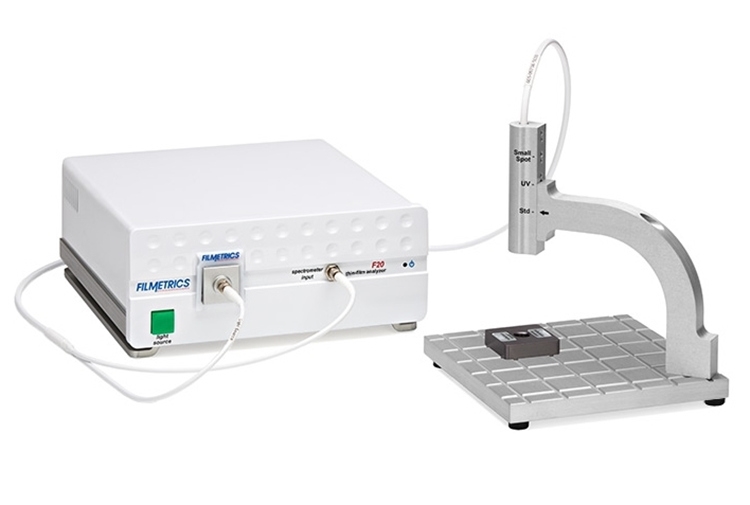
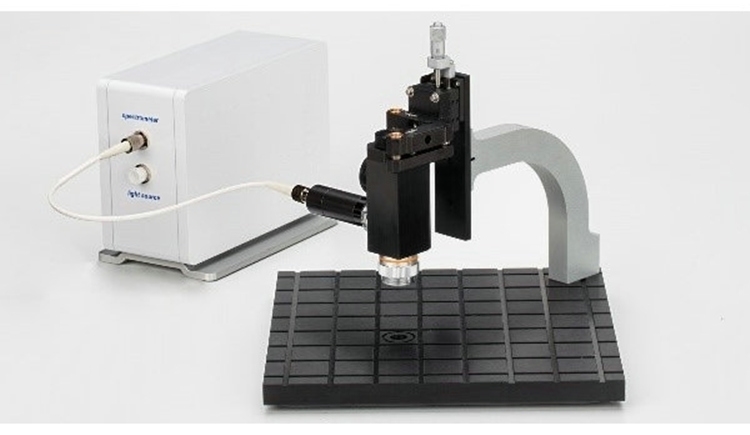
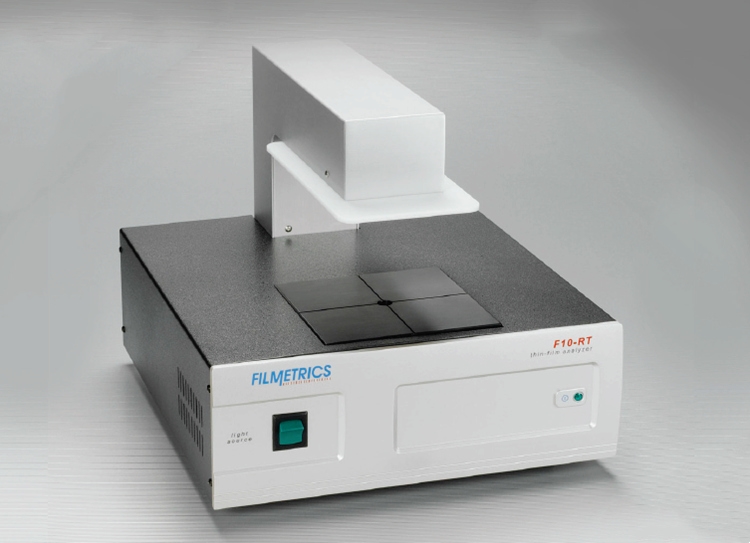
Daimei has launched the FilmetricF3-sX series spectral reflectometer for opaque materials such as semiconductor silicon wafers and thick photoresist. The device uses 980-1550nm near-infrared light to decipher the internal structure of 3mm thick SU-8 photoresist by measuring the phase modulation of the reflected spectrum. In 8-inch wafer thickness detection, a 10 μ m diameter spot can penetrate non transparent film layers. Combined with the Tauc Lorentz model, the full thickness distribution mapping of the wafer can be completed within 0.5 seconds with a repeatability deviation of less than 0.3 μ m. Its embedded diagnostic system can also monitor membrane stress in real-time, providing data support for process optimization.
From the "tactile perception" of contact probes to the "penetration analysis" of spectral reflections, Daimei Instruments breaks measurement boundaries with a multi-dimensional technology matrix. Its equipment not only passes ISO17025 certification, but also deeply integrates into the mass production loop of industries such as semiconductors, optoelectronics, and new energy, writing a new chapter in China's precision manufacturing with precise "thickness language".