-
E-mail
huogang010@163.com
-
Phone
13911564578
-
Address
Jisheng Villa 19-11, Changping District, Beijing
Beijing Zhongxian Hengye Instrument Co., Ltd
Cross scale multimodality: Zeiss microscope reshaping and exploring new paradigms in cultural and museum research
Date: 2025-11-25Read: 1
The exploration in the field of archaeology and cultural heritage has always relied on the analysis of "details", from microscopic traces on the surface of cultural relics to the ultrastructure inside fossils, from precise analysis of material composition to complete restoration of three-dimensional forms. The development of microscopic technology directly promotes the deepening of archaeological cognition. Having nearby 180 Carl Zeiss, which has been innovating for years, utilizes a cross scale and multimodal microscopic characterization platform to integrate optical microscopes, electron microscopesXThe deep integration of technologies such as X-ray microscopy provides non-destructive and high-resolution solutions for archaeological and cultural research, demonstrating value in cultural relic protection, paleontological research, and historical puzzle solving.
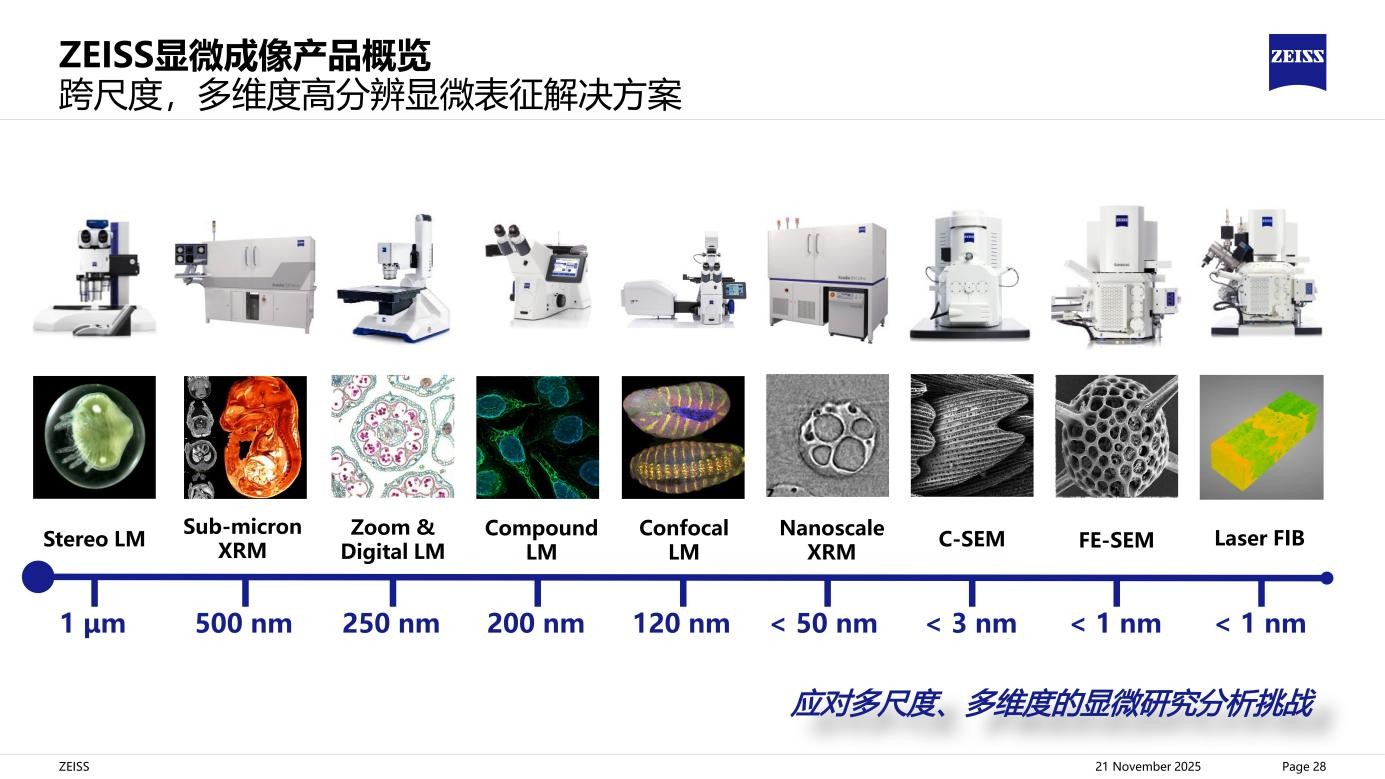
Zeiss microscope products: a cross scale, multi-dimensional, and multimodal research platform
The core advantage of Zeiss microscopes lies in the construction of a cross scale research system from macroscopic to nanoscale, achieving seamless integration from observing millimeter scale large samples to analyzing nanoscale microstructures. Its product matrix includes stereo microscopes and laser confocal microscopes(LSM)High resolution field emission scanning electron microscope(FE - SEM)TheXX-ray microscope(XRM)Focused ion beam scanning electron microscope(FIB - SEM)Wait, the resolution is 1MmExpand to less than1nmIt meets the representation needs of different scales in archaeological research.

Zeiss Laser Confocal Microscope: Surface roughness, 3D morphology, structural measurement, fluorescence imaging, in-situ testing
More importantly, Zeiss' innovative correlation microscopy characterization technology combines multiple imaging modalities organically - optical microscopy(LM)Provide color information and rapid characterization over a large area using scanning electron microscopy(SEM)Realize nanoscale high-resolution morphology observation and elemental analysis, Raman spectroscopy(Raman)Interpreting molecular structure and crystallinity,XThe X-ray microscope completes three-dimensional non-destructive imaging, complementing multidimensional information and breaking through the limitations of a single technology.
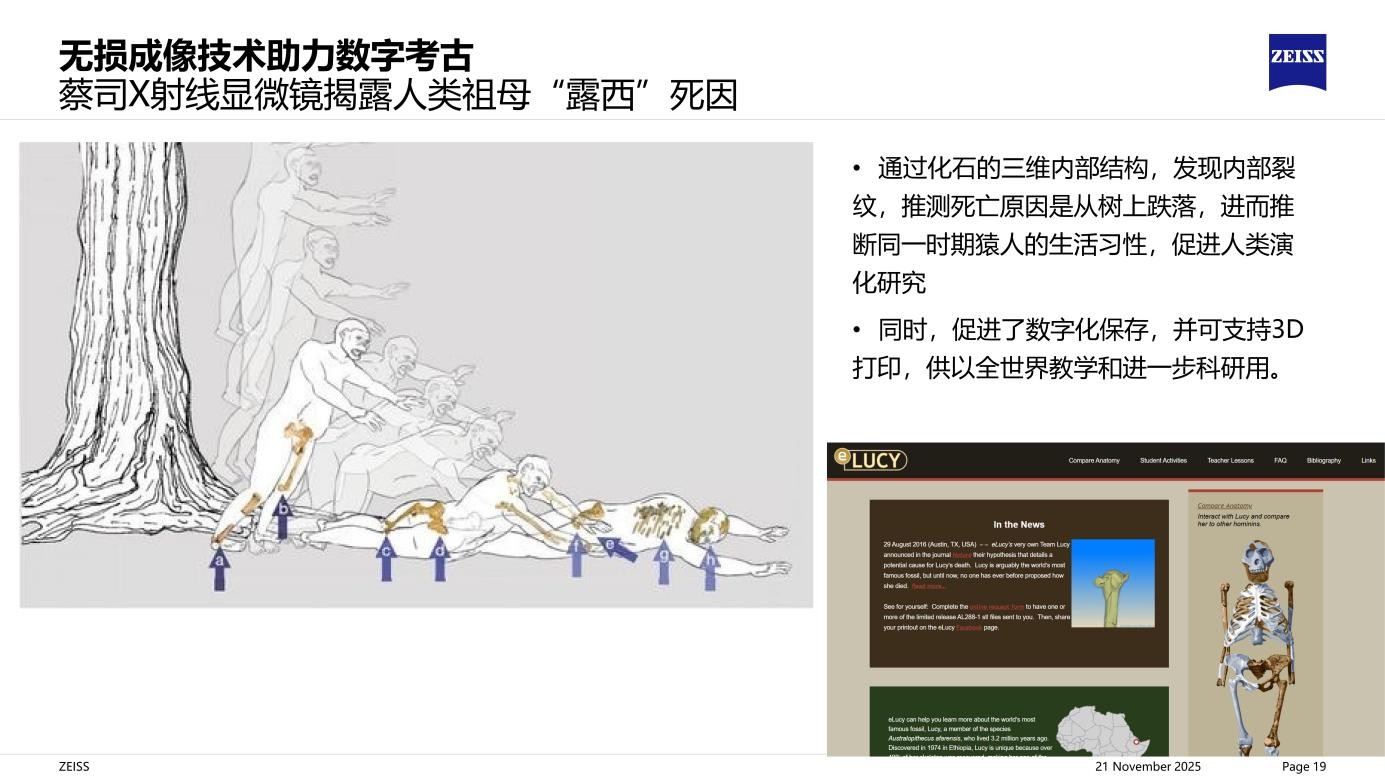
Non destructive imaging technology helps digital archaeology: ZeissXX-ray microscope reveals cause of death of human grandmother 'Lucy'
Non destructive testing is a core requirement in the field of archaeology and cultural heritage, Zeiss XX-ray microscope(XRM)By virtue of“Penetrating imaging”Technology, becoming a research tool for cultural relics and fossils“Non destructive tool”In the human grandmother“Lucy”In the study of fossils, Zeiss XRMThrough 3D non-destructive imaging, the subtle cracks inside the fossil were clearly presented, and the research team inferred that Lucy's death was caused by falling from a tall tree, providing a key basis for reconstructing the living habits and evolutionary environment of early humans. Meanwhile, the digital 3D data generated by this technology not only enables the preservation of precious fossils, but also supports 3DPrinting replicas enables global researchers and the public to share this important specimen of human evolution.
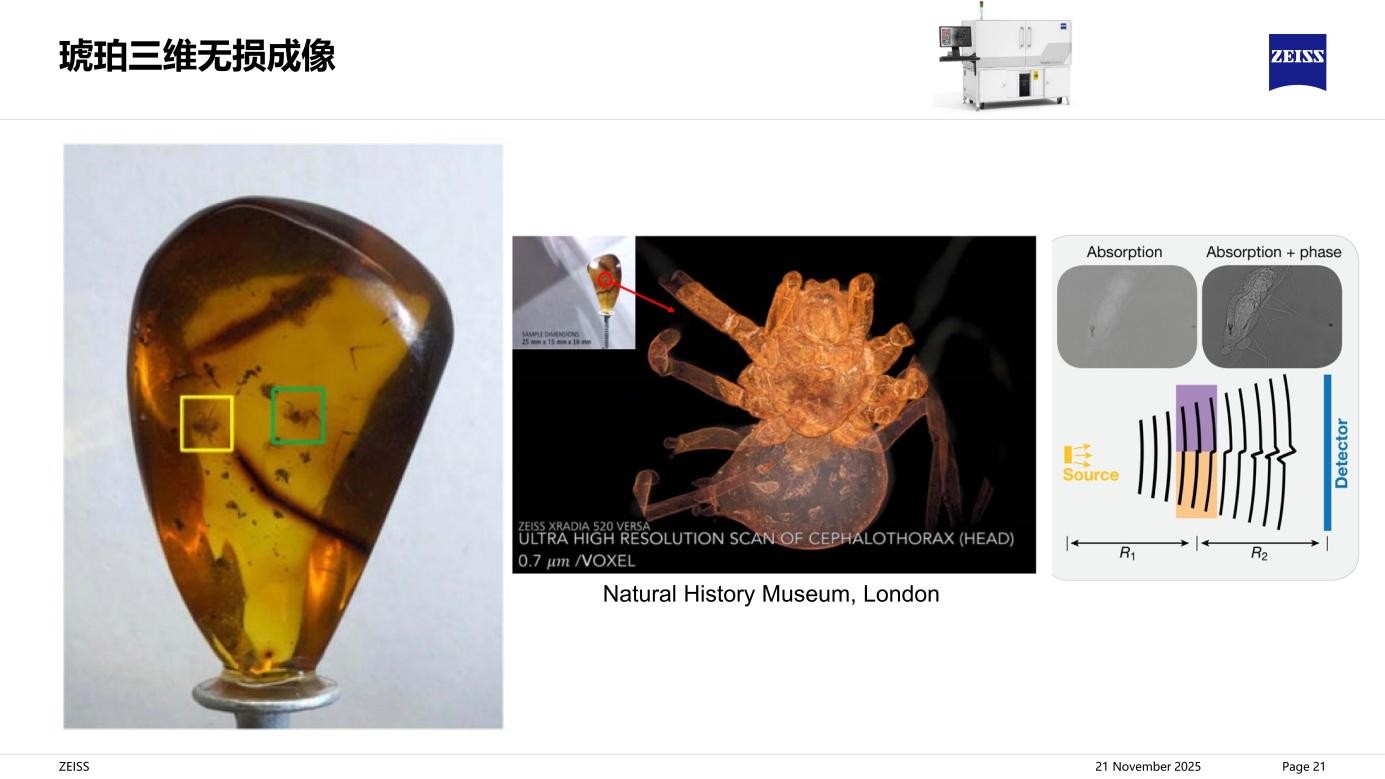
Amber 3D Non Destructive Imaging
For fragile cultural relics such as amber and embryonic fossils,XRMThe ultra-high resolution scanning capability has more advantages. The Natural History Museum in London utilizes ZeissXRMScan the head and chest structures in amber to 0.7Mm/The accuracy of voxels enables three-dimensional reconstruction of internal biological structures, avoiding irreversible damage to specimens caused by traditional slicing while preserving the original morphological information intact. In the study of Cambrian embryonic fossils,XRMandFIB - SEMThe correlation technology has achieved significant results: firstly, throughXRMNon destructive localization of key areas such as cell nuclei for reuseFIB - SEMPerform nanoscale 3D reconstruction,2500 A slice10nmThe high-precision data of pixel size allows researchers to gain insight into the developmental details of ancient life, and the reconstruction efficiency is improved compared to traditional methods. upgrade to3 - 5Twice.
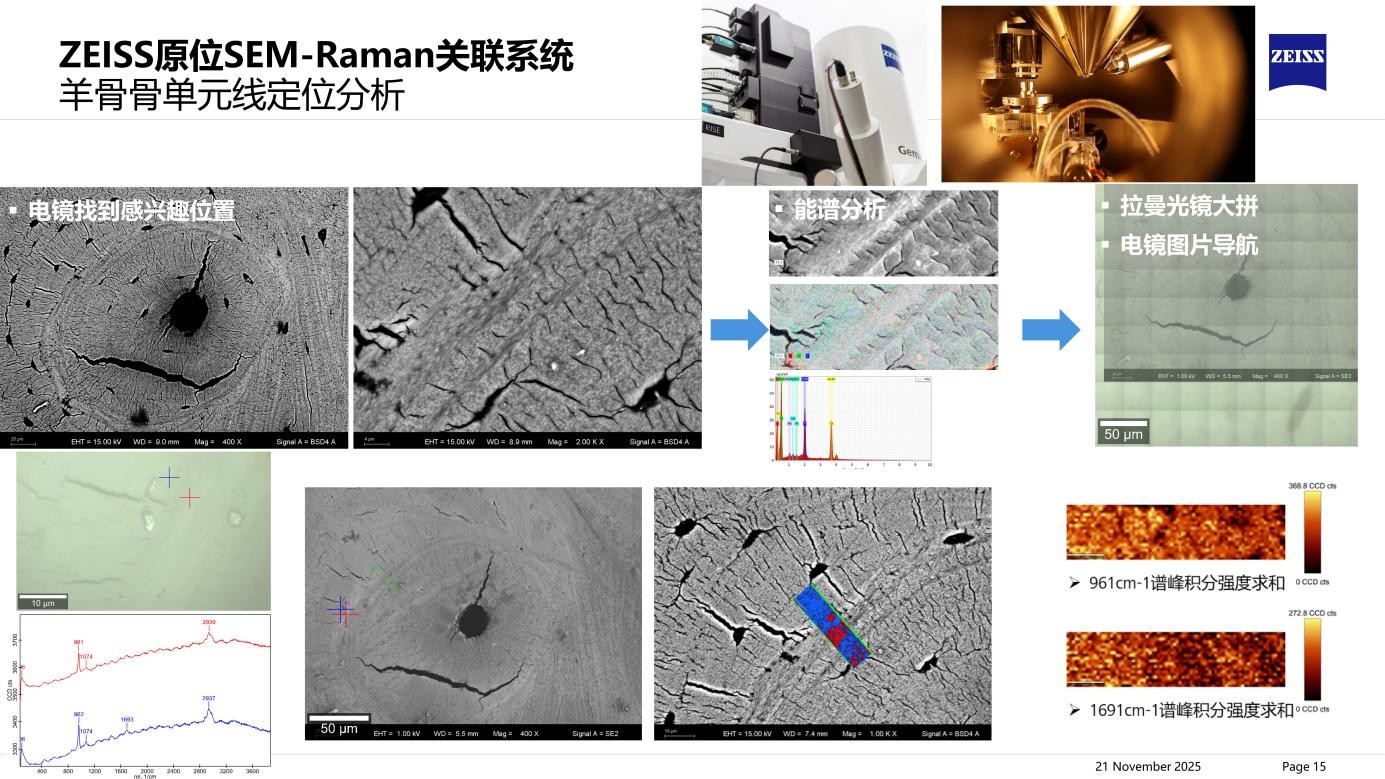
Zeiss in-situSEM-Ramancorrelation system
High resolution analysis and multimodal integration technology provide scientific support for the study of cultural relic materials and the resolution of historical mysteries. The surface roughness, three-dimensional morphology, and structural measurement of Song Dynasty ceramic tiles were studied using a Zeiss laser confocal microscope. This microscope is equipped with80nmThe fluorescence resolution and non-contact detection method accurately obtain surface roughness data without damaging cultural relics(Sq = 2.722Mm)This provides quantitative indicators for the determination of ceramic tile firing technology and the determination of the age. In the study of metal cultural relics subjected to bacterial erosion, the fluorescence imaging function of confocal microscopy can clearly distinguish between dead bacteria (in red) and live bacteria (in green). Combined with the measurement of pit depth and contour extraction technology, it provides a direct reference for the study of corrosion mechanisms and the formulation of protection plans for metal cultural relics.
In the field of paleontological research, ZeissSEM - RamanThe associated system has achieved high-resolution imaging+Collaborative breakthrough in molecular structure analysis. The research team first used scanning electron microscopy to study the gill arch carbonaceous membrane of Yunnan worm fossils in the Chengjiang biota(SEM)Locate the target area and use Raman spectroscopy for peak fitting analysis to deduce the highest temperature experienced by the fossil in reverse150 - 300The scientific hypothesis that thermal metamorphism leads to organic matter homogenization has been validated, challenging the traditional view of ultrastructure preservation. This "label free, in-situ linkage" analysis mode avoids the loss and positioning deviation of samples during transmission between different instruments, providing a new research approach for the study of paleontological evolution and burial mechanisms.
The application scope of Zeiss microscope is not limited to academic research, but also plays a key role in cultural relic protection and digital inheritance. For vulnerable cultural relics such as Song Dynasty ceramic tiles and ancient metal objects, non-contact detection and non-destructive imaging technology can complete material analysis and disease diagnosis without interfering with the original state of the cultural relics; The generated 3D digital model provides accurate data support for the restoration simulation and virtual display of cultural relics. In the study of early Cambrian post oral animal fossils in Shaanxi, Cai SiXradia - 510Microcomputer tomography technology1MmThe pixel accuracy has been obtained990Zhang's continuous images, after three-dimensional reconstruction, clearly present the internal anatomical structure of the fossil, providing valuable visual data for early life evolution research.
From exploring major mysteries of human evolution to analyzing the craftsmanship of ancient cultural relics, from studying the ultrastructure of ancient life to the digital preservation of cultural relics, Zeiss microscopes have redefined the technical scope of archaeological and cultural research with their cross scale observation capabilities, multimodal analysis dimensions, and non-destructive technology concepts. It not only enables researchers to observe the microscopic world that was previously difficult to reach, but also promotes the transformation of archaeology from traditional empirical judgment to a new paradigm of scientific and quantitative analysis through precise data support. In the future, with the continuous upgrading of related technologies and the deepening of interdisciplinary cooperation, Zeiss microscopes will play a more important role in cultural heritage protection, ancient civilization tracing and other fields, promoting more dormant cultural relics and fossils to "reveal information" and injecting lasting power into the inheritance and exploration of human civilization.