-
E-mail
info@bjzetron.com
-
Phone
15699785629
-
Address
Room 20E, Building 1-A, No. 48 Dongzhimen Outer Street, Dongcheng District, Beijing
About Us
Beijing Zechuan Technology Co., Ltd
Date: 2023-01-13Read: 0
We have all entered underground garages to varying degrees, and wherever we are, there always seems to be a very dull and oppressive sense of dust accumulation in the air. I wonder if everyone feels the same way.
One of the main reasons for this feeling is that the air circulation is poor, and underground garages do not have exhaust systems installed. Only the inlet and outlet can be ventilated, and the air is like stagnant water, especially the deep air, which feels a bit like a tomb in a novel!
At the same time, there is also a large amount of car exhaust in the garage. The gases emitted from car exhaust mainly include carbon monoxide, sulfur dioxide, nitrogen oxides, particulate matter, formaldehyde, and lead compounds used in leaded gasoline, which can have harmful effects on the central nervous system and cardiovascular system of the human body. These harmful gases sink in the garage and cannot be discharged. People with poor physical condition will feel dizzy after staying in the garage for a long time!
The production of carbon monoxide in underground garages mainly comes from car engines. When the engine is idling, due to insufficient combustion of gasoline, a large amount of CO containing exhaust gas will be produced. Underground parking lots are enclosed environments where vehicles frequently enter and exit, and the exhaust emissions are difficult to release. This can easily accumulate a large amount of CO gas, causing a pungent odor to pervade the parking lot and harming human health. If the gas concentration is too high, it can even cause fires and explosions.
In recent years, the national and local governments have also attached great importance to the CO detection system for underground parking garages.
According to the national standard GB/T50378-2014, the evaluation standard for green buildingsThe underground garage is equipped with a CO monitoring device that is linked to the exhaust equipment.
According to the hygiene standards for the design of industrial enterprises GBZ1-2002The maximum allowable concentration of CO in the workshop is 30mg/m3. When the operation time does not exceed 30 minutes at a time, the allowable concentration of CO can be relaxed to 100mg/m3. When the operation time is within 10-20 minutes, the maximum allowable concentration is 200mg/m3.
The existence of carbon monoxide detection in underground garages is necessary. Cars have entered thousands of households, and although new energy vehicles have emerged, they have not yet been fully popularized. Therefore, gasoline burning cars still have a long way to go. For the improvement of the earth's environment and the health of human beings, paying attention to the issue of carbon monoxide in underground garages is also for the safety of human beings.
Solution
The purpose of installing an online gas monitoring system is to:
1) Personal safety: entry into the ambient airReal time monitoring and regular ventilation are carried out to ensure that the concentration of carbon monoxide in the garage is below the hazardous level.
2) Environmental protection and energy conservation: Set an alarm value based on the concentration of carbon monoxide in the underground garage, link the fan, and avoid energy waste caused by excessive exhaust frequency.
Monitoring location: on the rear wall and pillar of the vehicle
Monitoring factors: carbon monoxide (CO), carbon dioxide (CO2), oxygen (O2)
Data transmission: wired or wireless transmission
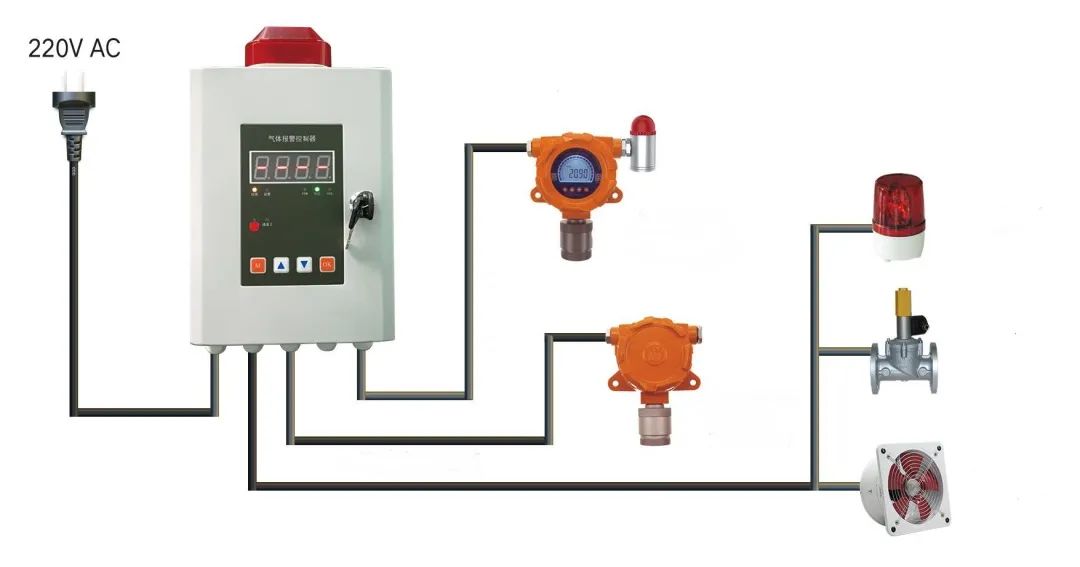
1) Wired transmission: The gas detection alarm device transmits a 4-20mA current signal or RS485 bus based digital signal to the gas alarm controller, which is then converted into an RS232 signal and transmitted to the computer terminal;
2) Wireless transmission: The gas detection alarm device transmits data to the gas alarm controller through RTU433 or GPRS wireless transmission, and then wirelessly transmits it to the computer terminal through the Internet network.
The MIC100 fixed gas detector can meet the on-site sound and light alarm prompts for detecting harmful gases such as CO, and display real-time monitoring of gas concentration on site. It also adopts infrared remote control, and parameter settings can be made without opening the cover during fixed installation.


| gas | range | resolution |
| Oxygen O2 | 0-30%VOL | 0.1%VOL |
| Hydrogen sulfide H2S | 0-100ppm | 1ppm |
| Carbon monoxide CO | 0-500ppm | 1ppm |
| Gaseous EX | 0-100%LEL | 1%LEL |
Suitable for various hazardous industrial sites, such as metallurgy, petroleum and petrochemical, municipal, chemical, biopharmaceutical, home environmental protection, school laboratories, automobile exhaust, etc.