-
E-mail
sales@eco-tech.com.cn
-
Phone
18210150760
-
Address
101B, Unit 1, Building 6, Courtyard 3, Gaolizhang Road, Haidian District, Beijing
Beijing Yiketai Ecological Technology Co., Ltd
How much do you know about plant phenotypes? Taking the response of different genotypes of wheat to drought and heat stress as an example
Date: 2025-10-31Read: 0
ØWhat is PlantPhenomics?
Plant phenomics is the study of plant phenotypes by using phenotype analysis systems to screen for ideal agricultural traits under unfavorable conditionsDevelopment, physiological activity, and health statusDiscipline. This method adopts comprehensive technical means and can dynamically evaluate the stress response of plants, with the advantage of high temporal resolution. With the help of an integrated high-throughput plant phenotype analysis platform, combined with imaging sensors, robotics technology, and computer vision technology, dynamic non-destructive testing of various plant traits can be achieved. It is crucial to evaluate the performance of plants under abiotic stress by screening for phenotypic characteristics such as growth rate, photosynthetic activity, and temperature tolerance, in order to select varieties with excellent stress resistance.

ØWhat are phenotype techniques?
RGBimagingtechnology:Capture color images to quantify plantsMorphological parameters, such as plant height, canopy area, volume, leaf inclination angle, etcIn addition,It can also be analyzedLeaf color changes are used to detect leaf aging.
chlorophyll fluorescence/Multispectral fluorescence imagingtechnologyChlorophyll fluorescence measurementAs an optical systemII(PSII)Active non-invasive detection methods can be used to monitor plant photosynthetic status and detect under stress conditionsPSIIFunctional impairment.Multispectral fluorescence is a sensitive indicator of secondary metabolism levels and stress states.
infrared thermographytechnology:Measuring canopy temperature can intuitively reflect stomatal regulation mechanism and leaf heat dissipation capacityfor exampleThe temperature difference between the canopy (i.e. the temperature difference between the air and the leaves) reflects the plant's tolerance to drought and high temperature stress.
hyperspectral imagingTechnology: By capturing spectral information from hundreds of consecutive bands, it is possible to finely analyze biochemical parameters such as pigment content, water status, and nitrogen levels in plants, providing a unique perspective for early and non-invasive diagnosis of plant stress response.
In addition, it also includes3Dlaser scanningTechnical Construction3View images and data, etc. Imaging system combinationmobile platform、Light source cultivation、weighing/irrigate、environmental monitoring、Powerful control and data analysis softwareWait, constituteAutomated, intelligent, high-throughput phenotype analysis tools.
ØYiketai Ecological Technology——Provide professional and comprehensive plant phenotype solutions
Yiketai is a professional chlorophyll fluorescence specialist/Multispectral fluorescence imaging technology, hyperspectral imaging technologyThermo-RGBA provider of imaging technology and other products, committed to providing advanced phenotype system solutions for scientific research and application fields, withPlantScreenPhenotypic imaging technology,PhenoTronPhenotype analysis platformPhenoPlotThe series of products such as near earth remote sensing platforms and digital plant factories have different applicable solutions for different scenarios such as laboratories, greenhouses, and fields.

ØWhat is the practical application of Yiketai phenotype? Taking the study of wheat stress response as an example
Published in Agronomy《Investigating Combined Drought- and Heat Stress Effects in Wheat under Controlled Conditions by Dynamic Image-Based Phenotyping》The research, just adoptPlantScreenHigh throughput phenotype imaging analysis technology was used to comprehensively evaluate the effects of drought, high temperature, and their combined stress on four Nordic wheat genotypesSelect varieties with strong tolerance.
In the context of climate change, drought and high temperature stress have become the main challenges affecting crop yields, thereforefilterWheat varieties that can adapt to harsh weather conditions,yesKey research directions in crop breeding and production.due toPlants have evolved multiple adaptive physiological and metabolic mechanisms, and different genotypes have varying degrees of sensitivity to stress. Numerous studies have delved into the physiological response mechanisms of crops to a single stress. However, the combined effects of crops on various abiotic stressesofThe reactions were vastly different.
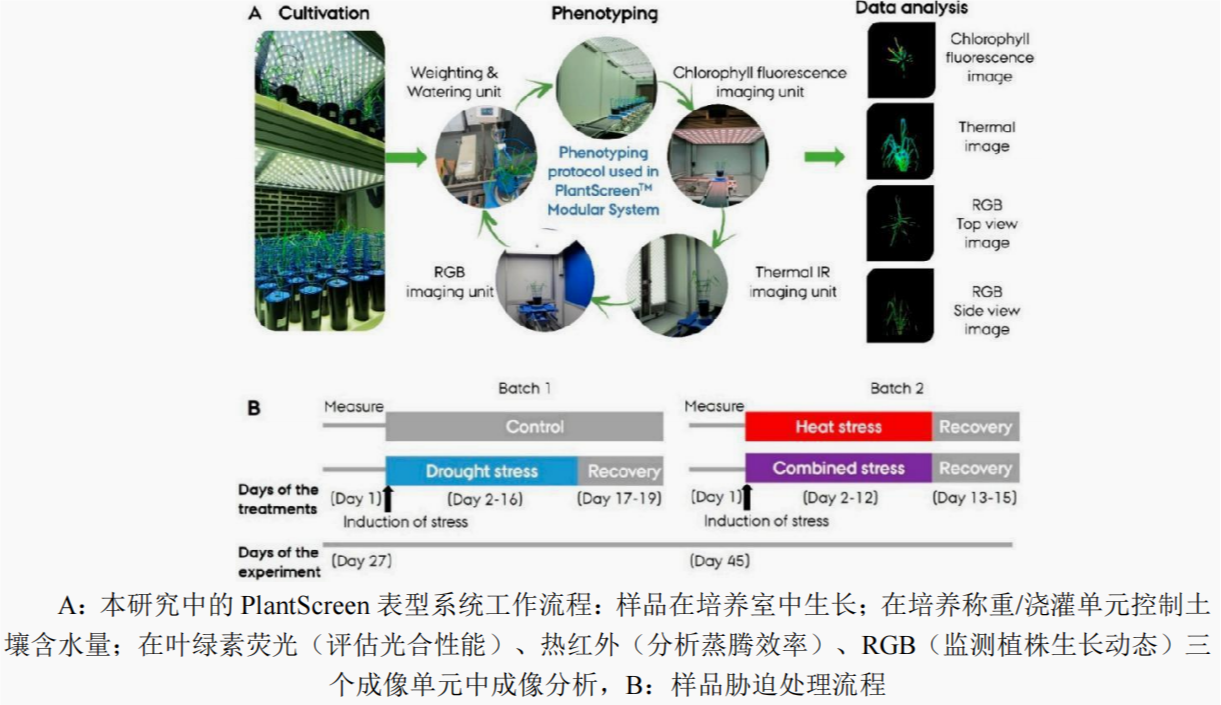
In this study,Select four genotypes based on thermal sensitivity(Thermal sensitive type:LM19TheSF1Heat tolerant type:LM62TheNS3)Researchers ontillering stagewheatThe plants were subjected to four stress treatments: control group, drought stress, high temperature stress, and combined effects of drought and high temperature.droughthandle16Heaven, high temperature, and compound stressAll processed11Oh my god, after that3Day recovery period.passPlantScreenphenotypeanalysis systemRGBQuantitative evaluation was conducted on the morphological and physiological characteristics of plants during the early, late, and recovery stages of stress.
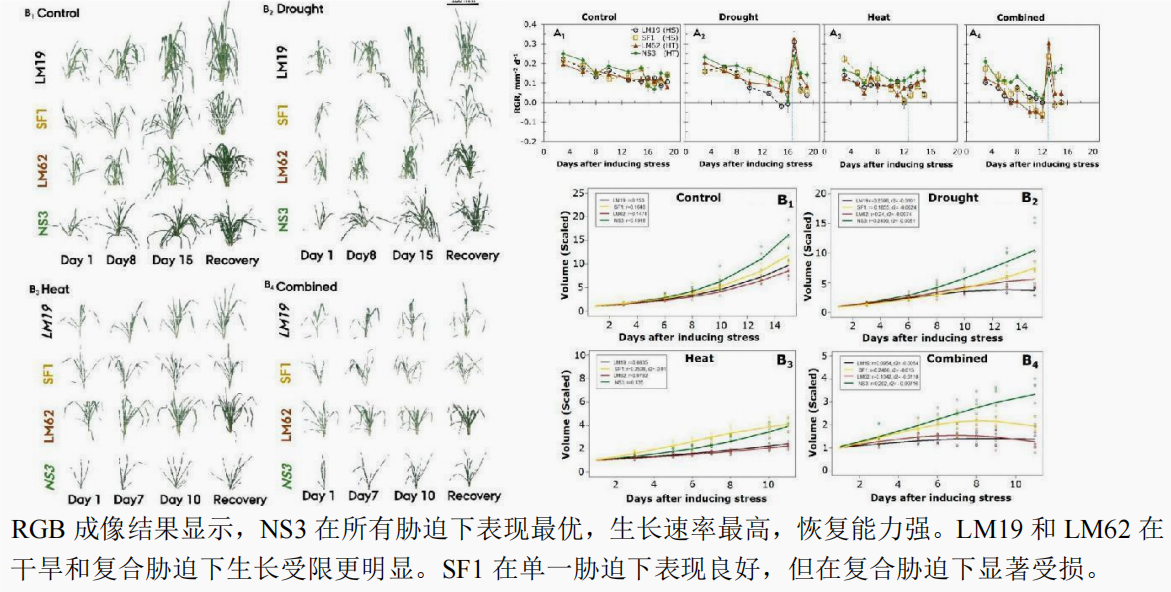
1. Morphological analysis(RGBImaging)
Continuously topping wheat(top view)And the side(side view)ImagingmonitorObtain relative growth rate(RGR)Analyzing plant volume and other characteristic parameters4A genotype of wheatGrowth differences under different stress conditions.
2. Photosynthetic performance (chlorophyll fluorescence imaging)
The chlorophyll fluorescence imaging monitoring part of the experiment was designed with two schemes: a light adaptation measurement program and a dark adaptation and light response curve measurement program, which were used at different times of the dayPlantScreenThe system automatically completes and analyzesFq’/Fm’(PSII Operating Efficiency)qL(PSII. Reflecting the proportion of center development and the adaptability of plant photosynthesisFv/Fm(PSII Maximum Photon Efficiency)TheNPQ(Non photochemical fluorescence quenching, reaction heat dissipation)By observing changes in fluorescence parameters, the response differences of different genotypes under different stresses can be obtained.

The chlorophyll fluorescence imaging results showed that,LM19andLM62Genotypes are more sensitive to late stage drought stress;Thermosensitive genotypeExtremely low tolerance to late stage heat stress;NS3Maintaining a high photosystem under complex stressIIefficiencyIt also exhibits strong photosynthetic and restorative abilities during a single stage of stress.Fv/FmThere was no significant difference under drought stress, which may be due to insufficient stress level, consistent with previous drought research conclusions
3. Stomata and transpiration (infrared thermography)
Canopy temperature is an important physiological characteristic that can be used to screen for heat sensitive and heat-resistant genotypes, as it reflects carbon dioxide assimilation and stomatal regulation in the canopy. This study monitored wheat canopy temperature using thermal infrared imaging technology.

4. Handheld device assisted verification
The study also utilizedPolyPen RP410Handheld hyperspectral measuring instrument andFP100(FP110The previous version of the handheld fluorescence measuring instrument was used to measure wheat
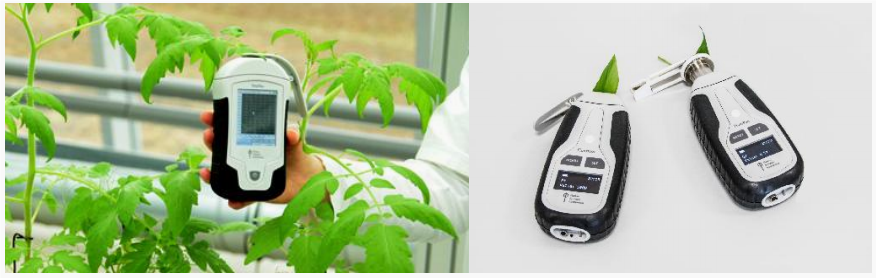
PolyPen RP410Mainly used to obtain vegetation indices that reflect plant pigments, health, and other information, this can also be achieved by configuring more powerful hyperspectral imaging units in the phenotype system.FP100It is mainly used for comparison with phenotype imaging data.

In the study, data such as soil moisture and chlorophyll content were also combined to comprehensively evaluate and analyze the stress response and mechanism of different genotypes of wheat, proving thatNS3It is a tolerant genotype with strong adaptability, especially outstanding under complex stress.SF1Has good tolerance to single stress, but is sensitive to complex stress.LM19andLM62In droughtpost-productionUnder combined stress, the performance is poor. phenotypebecomeTechnologies can effectively and dynamically evaluate the response of wheat to complex environmental stresses, providing reliable tools for breeding.
Yiketai Ecological Technology Company hasEcoTechLaboratory, Spectral Imaging and Unmanned Aerial Vehicle Remote Sensing Technology Research CenterSpectrAPPSpectral Imaging Innovation Application Project,The technical equipment mentioned in the article is provided by Yiketai. Welcome to learn more!
