-
E-mail
sales@eco-tech.com.cn
-
Phone
18210150760
-
Address
101B, Unit 1, Building 6, Courtyard 3, Gaolizhang Road, Haidian District, Beijing
Beijing Yiketai Ecological Technology Co., Ltd
Empowering medicinal plant research - Yiketai phenotype equipment landing at Jilin Agricultural University
Date: 2025-11-10Read: 0
Recently, Beijing Yiketai Ecological Technology Co., Ltd. successfully completed the installation and commissioning of multiple sets of plant phenotype analysis equipment at Jilin Agricultural University, helping the university achieve visible light-Near infrared hyperspectral imaging, chlorophyll fluorescence imaging, multispectral fluorescence imaging, and plant imagingfluorescent proteinComprehensive upgrade and deep application of core technologies such as live imaging.

The phenotype series equipment delivered this time is specially designed for the research and development of medicinal plants, and can perform non-contact and non-destructive testing on seedlings and canopies. The equipment can accurately achieve quantitative and qualitative analysis of the growth and development status, physiological and ecological characteristics, and photochemical utilization efficiency of medicinal plants. At the same time, it can efficiently identify biotic stresses such as diseases and pests, as well as abiotic stresses such as drought and salinity, accurately detect plant water and pigment content, and provide key data support for the screening of resistant germplasm.
This set of equipment combines the stability of greenhouse experiments with the mobility of field operations, greatly improving research efficiency and widely serving multiple research scenarios such as rapid screening of excellent germplasm traits of medicinal plants, genetic breeding, phenotype omics research, physiological and ecological analysis, germplasm resource trait detection, efficient seedling breeding, and phenotype big data monitoring. It injects new technological impetus into the research of medicinal plants at Jilin Agricultural University.
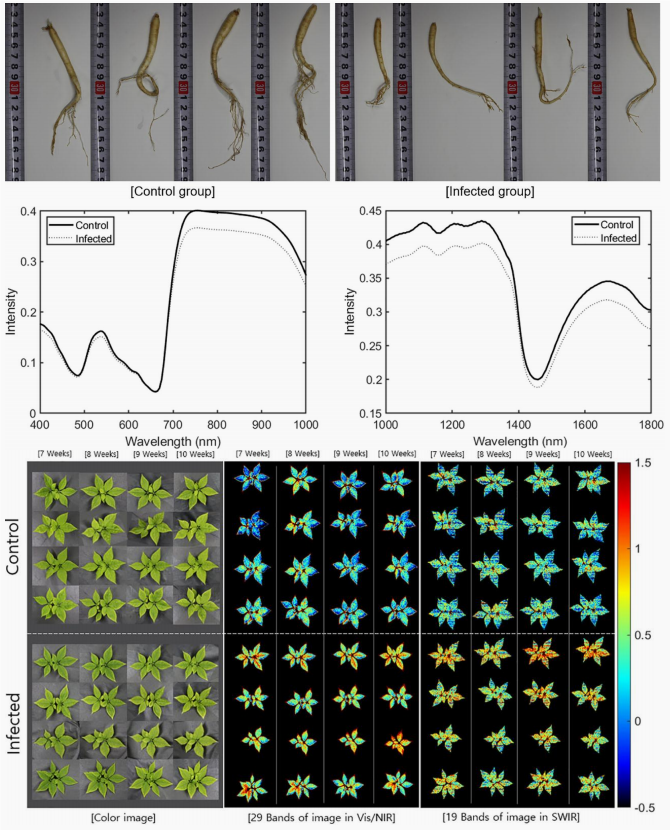
image1 Hyperspectral reflectance imaging for non-destructive evaluation of root rot disease in Korean ginseng: from top to bottomControl group and root rot infection groupComparative diagram of root development; Two groups are visible-Average spectra of near-infrared and shortwave infrared; Two sets of color images and multispectral images(Vis/NIRandSWIRDifferences in the main frequency bands in the region
Researchers from South Korea utilize400–1800 nmHyperspectral reflectance imaging technology provides an effective technical path for early non-destructive diagnosis, disease warning, and physiological mechanism analysis of Korean ginseng root rot disease(Eunsoo Park, etc. 2023). Research through VIP–SPAAlgorithm, filter out visible-Near infrared region29 Short wave infrared region19 These key bands correspond to the characteristic wavelengths of physiological components such as chlorophyll, carotenoids, starch, and phenolic compounds; Based on this constructionPLS-DAModel, visible-The average identification accuracy in the near-infrared region reaches84%Short wave infrared region95%And the short wave infrared region model is used after stress7–10 Zhou always maintains90%The above accuracy can accurately capture early physiological changes such as decreased nutrient absorption and decreased photosynthetic activity caused by diseases. This technologyNo need to damage the plants,The spectral inversion of underground root diseases through aboveground leaf spectra can solve the problems of time-consuming and difficult early detection in traditional detection, providing key support for field monitoring and green prevention and control of root rot disease in Korean ginseng.
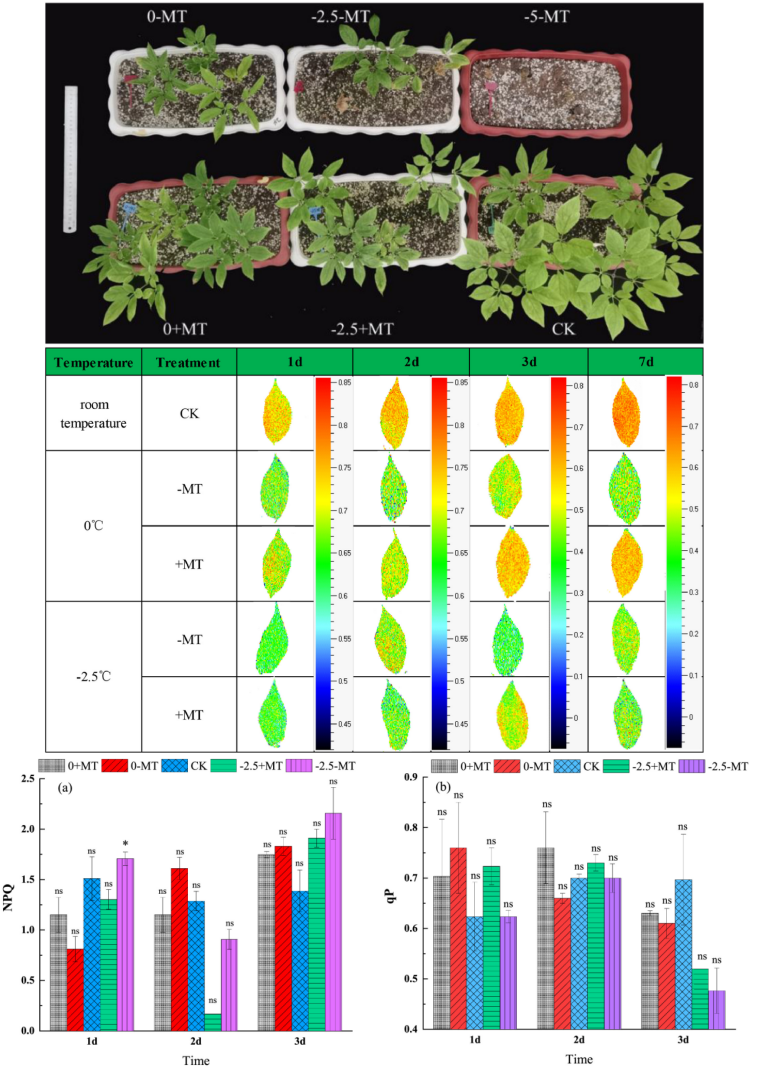
image2 The effect of melatonin on the phenotype and photosynthetic characteristics of ginseng leaves after freezing stress(Deyue Su, etc. 2024)Growth of ginseng seedlings under different treatments;Ginseng leavespieceofFv/FmFluorescence imaging changesNon photochemical quenching of fluorescence parameters in ginseng leaves(qP)And photochemical quenching(NPQ)Changes over time
The chlorophyll fluorescence imaging technology provides intuitive data basis for evaluating ginseng damage under freezing stress, verifying the relief effect of melatonin, and studying the stress resistance mechanism. By using the chlorophyll fluorescence imaging system for monitoring, it was found that,Fv/FmRatio (reflecting)PSⅡ The photochemical efficiency- 2.5After freezing stress at ℃, the temperature significantly decreased 0.78 Below, while spraying100 nmol・L⁻¹melatonin 1 After a week, the ratio can recover to 0.8 above;NPQ(Non photochemical quenching, reflecting photoprotective ability) After stress, the untreated group showed an increase compared to the control group11.44%The application group showed a significant decrease, indicating that melatonin can alleviate photoinhibition damage. Chlorophyll fluorescence imaging technology can non destructively and visually present the effects and mitigation effects of freezing stress on the photosynthetic system of ginseng, dynamically track the process of leaf photosynthetic function recovery, and provide accurate phenotype observation methods for ginseng cold resistant cultivation and stress damage repair.
References:
Park E, Kim Y S, Faqeerzada M A, et al. Hyperspectral reflectance imaging for nondestructive evaluation of root rot in Korean ginseng (Panax ginseng Meyer)[J]. Frontiers in Plant Science, 2023, 14: 1109060.
Su D, Du L, Wang J, et al. Effects of melatonin on ginseng leaf phenotypic and photosynthetic properties following chilling and freezing stress[J]. Plant Stress, 2024, 14: 100599.
Beijing Yiketai is a domestic technology company specializing in plant phenotype analysis technology, dedicated to ecological protection-agriculture-For the promotion, research and development, and service of health research monitoring technology, please feel free to contact us(Beijing Yiketai)Get more information and customized comprehensive technical solutions: