-
E-mail
info@ourunet.com
-
Phone
13284477192
-
Address
Room 101, 1st Floor, Building 2, No. 35 Yanqi Street, Yanqi Economic Development Zone, Huairou District, Beijing
Beijing Ourun Scientific Instrument Co., Ltd
Fully automatic soil organic matter analyzer - precise and efficient promotion of soil detection technology upgrade
Date: 2025-12-04Read: 0
In today's era where modern agriculture and environmental protection are increasingly valued, organic matter, as a key component of soil, not only provides necessary nutrients but also effectively improves soil structure, making it one of the sources of nutrients for agricultural production. Therefore, accurate determination of soil organic matter content has become a key link in evaluating soil fertility, guiding scientific fertilization, and promoting the development of green agriculture.ORAutoSOM-60/80Fully automatic soil organic matter analyzer, reference standard《NY/T 1121.6-2006Soil testing6Part: Determination of Soil Organic Matter "can be achieved through intelligent design“Automatic liquid addition+Automatic digestion+Automatic titration+Automatically generate reports”The integrated testing process significantly reduces labor costs and meets the needs of batch testing. It is a fully automatic, high-precisionintelligent integrationThe soil organic matter detection instrument.
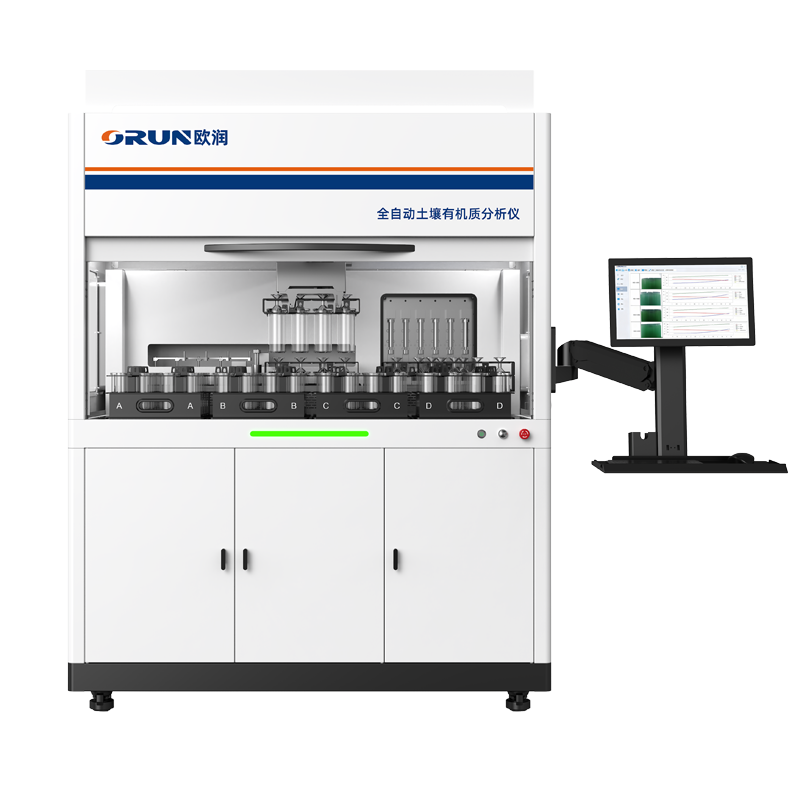
producthighlight
-Fully automated, saving labor:From sample capture, liquid addition, digestion, titration to result calculation, there is no need for manual intervention throughout the process, which can keep away from reagent contamination and greatly improve detection efficiency.
-Biomimetic visual titration systemCombining image recognition algorithms to automatically determine the endpoint of titration,Significantly reduce human errorEnsure datastable and reliable.
-High precision temperature control and timing controlPrecision of temperature control for graphite digestion±0.5 ℃Uniform heating temperature ensures sufficient digestionandData parallelism.
-Fast detection speed, efficient batch productionFour visual sensors and infusion pumps start simultaneously, and four drip positioning systems work simultaneously, significantly improving batch detection efficiency.
-Intelligent experiment management softwareOne click start stop, real-time display of titration curve and video, automatic generation of reports and datatrace to the source.
-Security system designBuilt in directional exhaust system, one click cleaning after the experiment, multiple alarms such as leakage protection, etc.
-Compliant with national standards: Compliant with standards《NY/T 1121.6-2006Soil testing6Part: Determination of Soil Organic Matter "data requirements, applicable to organic matter content< 15%Soil samples.
Applicable scenarios
-Agricultural research institutionsSoil fertility assessment and dynamic monitoring;
-Environmental monitoring stationInvestigation of Farmland Quality and Evaluation of Restoration Effectiveness;
-Third party testing laboratoryBatch testing of soil samples;
-University Teaching and Quality Inspection CenterSupporting teaching and research projects.
Application Solution
1. Reagent preparation
According to the standard《NY/T 1121.6-2006Soil testing6The reagent preparation method required in the "Determination of Organic Matter in Partial Soil" is used for preparation.
a.0.4 mol/Lpotassium dichromate-sulfuric acid solution
b.0.1 mol/LFerrous sulfate standard solution
c.Potassium dichromate standard solution(c (1/6K2Cr2O7=0.1000 mol/L))
d.Ortho phenanthroline(C12HgN2·H2O)Indicator
2. Sample determination process
Reference《NY/T 1121.6-2006Soil testing6Experimental procedure for the determination of organic matter in some soils, including instrument preparation and method setup. The specific steps are as follows:
①Power on, open the software and instrument, click“preheat”Button to preheat the digestion position.
②Insert each reagent tube into the corresponding prepared reagent bottle, insert the water addition tube into the pure water tank, and insert the waste liquid tube into the waste liquid tank.
③enter“wash”Interface, set the pre filled volume of the pipeline and save it, click“One click pre filling”Perform pipeline lubrication and reagent pump lubrication.
④Place the sample cup containing the sample on the sample holder and fix the sample holder in the designated position, while placing it in each sample cup1A rotor.
⑤Edit and save calibration methods and sample determination methods.
⑥Place the required calibration reagent samples into the sample rack, select the corresponding position in the sequence, and also choose the experimental method“calibration”Method, click“start”Conduct calibration experiments. The calibrated titrant concentration will be automatically imported into the sample determination method and participate in the calculation of the daily sample results.
⑦will takecsvThe format saved weighing data file can be imported into the software sequence with one click, and checked after importIs the sample sequence, weighing data, sample type, sample number, and other information correct.
⑧After verifying the accuracy, confirm whether the digestion temperature has reached the set temperature, and finally select the experimental method“Soil organic matter determination”Method, click“start”Conduct sample measurement experiments.
⑨After the experiment is completed, you can“data”View the experimental results on the interface.
⑩After confirming that the data is correct, the experimental report can be exported and printed.
⑪Clean the pipeline and sample cup. Insert each reagent tube into pure water and enter“wash”Interface, set the cleaning volume of the pipeline and reagent pump and save it, click“One-click cleaning”Complete the cleaning of pipelines and reagent pumps.
⑫After completing all experiments and cleaning, close the software and instruments.

image1 Experimental Method

image2 Experimental Procedure

image3 Real time titration curve and video
3. Solution Verification
Measure separately3Soil organic matter quality control samples of different concentrations were collected and tested in parallel8Next, calculate the relative standard deviation (% RSD)Compare the absolute difference to see if the result is within the given range, and comprehensively determine whether the detection result is required.
According to the experimental data, the detection results of the three concentrations of standard soil samples are within the specified range, and the data accuracy is good; relative standard deviationRSD(%)<3%This indicates good parallelism of the detection data and good instrument stability.

4. Precautions
a.Before the experiment, check if the reagents are sufficient for the required amount for this experiment. If the amount of reagent is insufficient, it is necessary to input the amount of added reagent in the remaining amount of reagent after the preparation is completed, to ensure that the software can display the remaining amount of reagent in real time, in order to avoid insufficient dosage and affecting the experimental results.
b.In low-temperature environments,prepare, compound, formulatePotassium dichromate-Sulfuric acid solution is prone to crystallization. When the temperature is low, remember to check before starting up. If crystallization occursneed重新配置。
c.Before and after each experiment, it is necessary to lubricate and wash the reagent tubing and pump.
d.Before the experiment, check whether all reagent pipelines are in the corresponding reagent bottles, whether the water addition pipeline is in the pure water tank, and whether the waste liquid pipeline is in the waste liquid tank.
e.Before the experiment, check whether there are rotors in each sample cup, whether the sample holder is placed in the designated position, and whether the digestion temperature is stable at the set temperature.
f.Before each experiment, it is necessary to calibrate the titrant and calculate the sample results based on the concentration calibrated on that day.
g.After importing the sequence, check whether the sample sequence, number, type, and other information are correct.
h.After the experiment, be sure to clean the sample cup thoroughly to avoid affecting the color judgment of subsequent experiments.
5. Solution Advantages
ORAutoSOM-60/80The fully automatic soil organic matter analyzer provides efficient, safe, and reliable testing solutions for laboratories. Whether it is daily testing or scientific analysis, it can achieve a series of intelligent operations such as unmanned operation, data traceability, and report export. One batch can be processed and tested60/80The sample has good data parallelism and high detection accuracy, truly achieving high-throughput, reliable, and fully automated detection.