-
E-mail
dfyuantong@163.com
-
Phone
13301057943
-
Address
1-603 Jialian Times Square, No. 6 Gulou South Street, Changping, Beijing
Beijing Dongfang Yuantong Technology Development Co., Ltd
The main difference between wiping test counter and surface contamination monitoring instrument
Date: 2025-11-10Read: 0
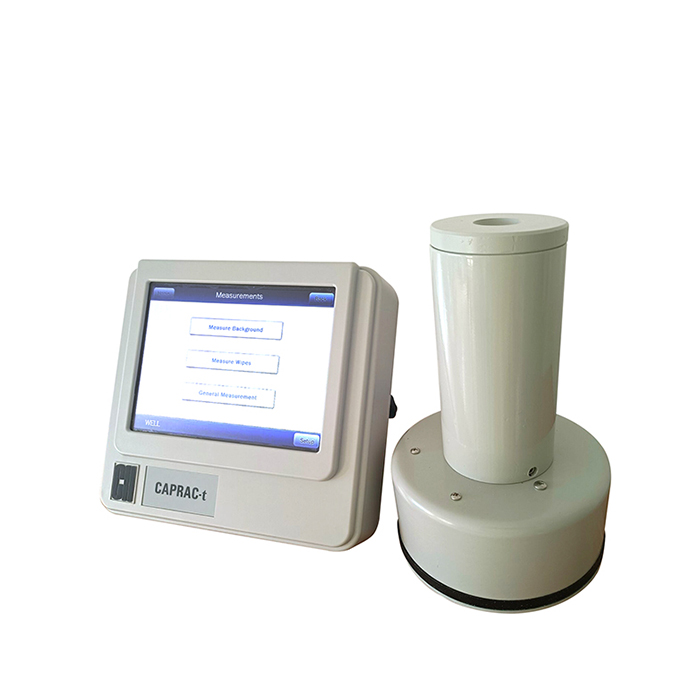
Capintec's CAPRAC-t is a desktop radioactivity counter specifically designed for wiping tests. Its core functions and application areas are very clear:
Main purpose:
1. Measure the radioactivity of the wiped sample: This is its most core function. Users use wiping materials (such as filter paper, cotton swabs) to wipe and sample surfaces suspected of radioactive contamination, and then place the wiping sample into Measure in CAPRAC-t. The instrument will accurately measure the activity of radioactive nuclides collected on the wiped sample (usually measured in Bq or μ Ci).
2. Quantitative assessment of surface pollution level: By measuring the activity of the wiped sample and combining it with the wiping area, the removable surface contamination level of the surface can be calculated. This is a very important monitoring indicator in nuclear safety regulations, used to evaluate the safety of the work environment and whether it complies with legal limits.
Main application areas:
1. Nuclear medicine department (hospital):
·Monitor areas such as injection rooms, packaging cabinets, dispensing stations, workbenches, patient examination beds, door handles, telephones, etc. for any removable contamination after the use of radioactive drugs (such as Tc-99m, I-131, F-18, etc.).
·Monitor the contamination of personal protective equipment such as hands, protective clothing, gloves, etc. by monitoring staff.
·Evaluate the effectiveness of cleaning procedures.
·Meet the requirements of regulatory agencies (such as NRC, EPA, local health departments) for regular wiping tests and records.
2. Radioactive Pharmacy/Laboratory:
·Strictly monitor the environmental pollution in the preparation, packaging, and quality control areas of radioactive drugs.
·Monitor the surface contamination of equipment, containers, and fume hoods.
3. Research laboratory: In laboratories that use radioactive isotopes for labeling, tracing, biological experiments, etc., monitor the contamination of work areas, equipment, and laboratory surfaces.
4. Nuclear facilities: Monitor and control the removable pollution of areas, equipment, and tools in places such as reactors, reprocessing plants, and waste treatment facilities.
5. Environmental monitoring: In some cases, it is used to wipe and collect environmental samples (such as soil, plant leaf surface sediments) for radioactivity measurement.
Difference from surface pollution detector
feature |
Surface pollution detector (Survey Meter) |
CAPRAC-t Wipe Test Counter |
test object |
Directly measure the radiation level of the surface itself. |
Measure the wiped sample (representing the removable contaminated portion of the surface). |
method |
Direct, in-situ, real-time measurement. The probe moves and scans on the surface of the object. |
Indirect measurement after sampling. It is necessary to manually wipe the sample before putting it into the instrument for analysis. |
main purpose |
Quickly screen large areas, identify pollution hotspots, and conduct preliminary qualitative analysis/Semi quantitative evaluation. Real time monitoring. |
Accurately and quantitatively measure the level of removable surface contamination at specific locations(Bq/cm²)。 Used for compliance recording and low-level pollution assessment. |
sensitivity |
Relatively low sensitivity to low-level pollution and susceptible to environmental background interference. Especially for low energyBeta nuclides (such as H-3, C-14, S-35) or small-scale contamination points may be difficult to detect. |
The sensitivity is very high. Placing the wiped sample close to the detector for shielding measurement greatly reduces background interference and can detect low-level pollution far below the direct measurement limit. Especially skilled in measuring low energyBeta and gamma nuclides. |
measurement results |
Usually displayed as count rate(CPS, CPM) or dose rate (μ Sv/h, mR/h). Conversion is required to estimate surface activity (Bq/cm ²), and accuracy is greatly affected by geometric conditions and nuclide types. |
Directly provide the total activity of the wiped sample(Bq or μ Ci). By combining the wiping area, the level of removable surface contamination (Bq/cm ²) that meets regulatory requirements can be directly calculated |
Applicable scenarios |
Large area rapid scanning, searching for pollution points, real-time monitoring during the work process, inspection before entering the control area, and emergency response to accidents. |
Regular compliance monitoring, precise assessment of low-level pollution, surfaces that are difficult to measure directly (such as irregular surfaces, equipment interiors, small areas), verification of cleaning effectiveness, and quantitative reports required by regulations. |
Instrument type |
Portable, handheld operation. |
Desktop instruments are fixed and placed in low background areas (such as lead shielded rooms) for use. |
detector |
Multiple types(The selection of GM tubes, plastic scintillators, NaI scintillators, etc. depends on the target nuclide.
|
Usually equipped with high-sensitivity detectors (such as gas flow proportional counters)β, Or NaI scintillators are used for gamma radiation and integrated into lead shielding bodies. |
Key Summary:
·Surface pollution detector (Survey Meter): yesRadar "or" flashlight "is used for rapid scanning, detection, and localization of pollution. The advantages are real-time, direct, and portable, but the disadvantages are limited sensitivity and difficult quantification, especially for low-level or low-energy nuclides.
·CAPRAC-t Wipe Test Counter: yesPrecision balance "or" laboratory analyzer "is used to accurately and quantitatively measure removable contaminants collected by wiping. The advantages are high sensitivity, accurate quantification, and compliance with regulatory reporting requirements. The disadvantages are the need for sampling, multiple steps, and non real time.
------Wipe the test countertechnologyPlease consult the technical consultant of Beijing Dongfang Yuantong Technology Development Co., Ltd., authorized general agent of Capintec in China, for any questions.