-
E-mail
info@tvscope.cn
-
Phone
15261811715
-
Address
Super dimensional scenery
Beijing Chaoweijing Biotechnology Co., Ltd
Cloud based Discussion on Brain Issue 85 Preview | Neuroregulation and Mechanisms of the Brain Lymphatic System
Date: 2025-07-17Read: 3
Welcome to the Young Neuroscientist Zoom forum on the cloud to share research achievements and experiences! Cloud Brain Forum is a public welfare forum initiated by Guo Yanmeng (UCSF), Ma Shaorong (UCSC), and Zhou Li (UCSF), postdoctoral fellows at the University of California, who graduated from the Institute of Neuroscience, Chinese Academy of Sciences, in April 2020. The current responsible persons are Guo Yanmeng, Ma Shaorong, Zhou Li, and Han Chuanliang. The forum will share and discuss the progress of neuroscience research in the form of online seminars, hoping to broaden the horizons of young neuroscientists around the world and promote the development of interdisciplinary research.
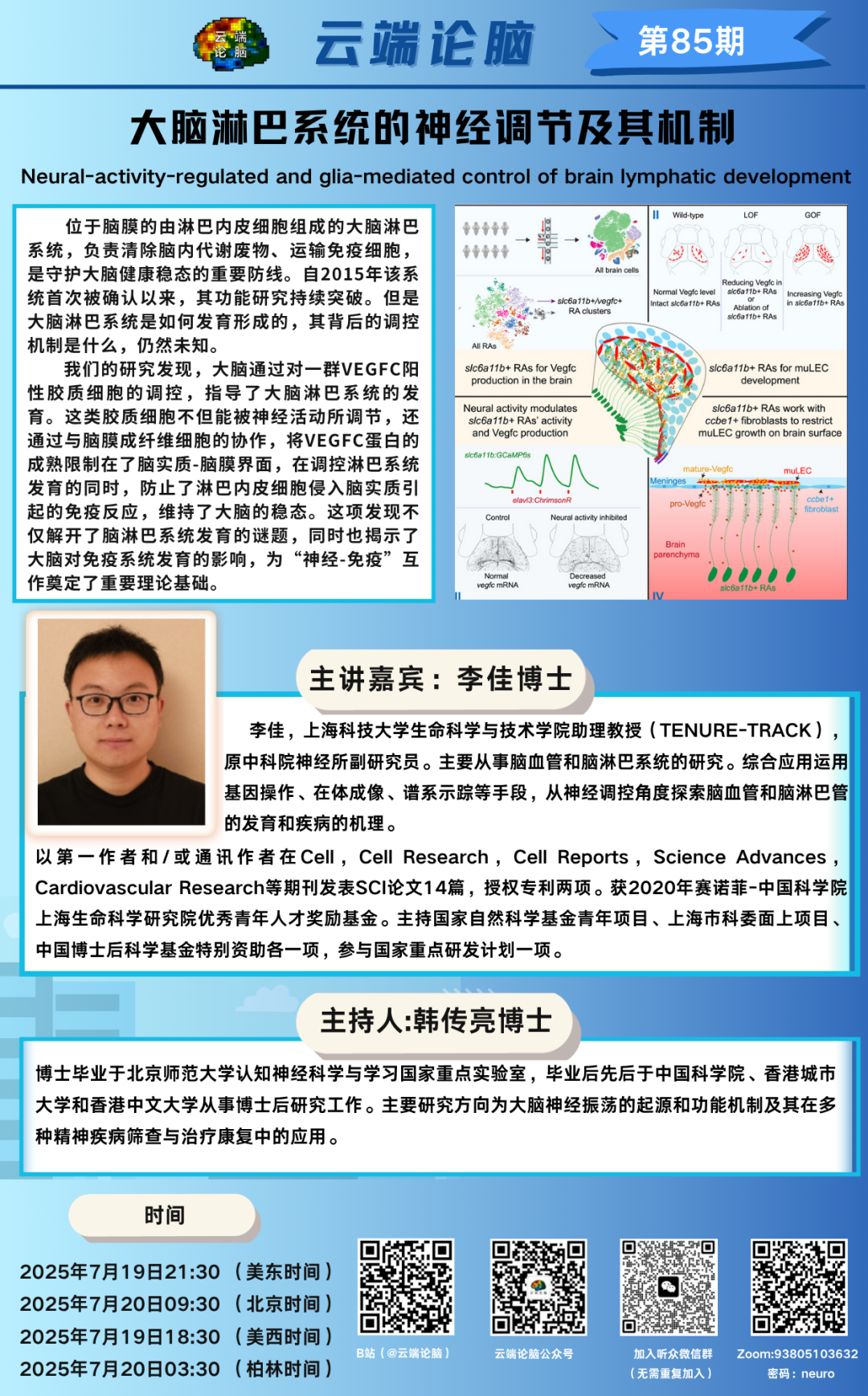
Scan the QR code on the poster above to watch the lecture
01 Introduction
The brain lymphatic system, composed of lymphatic endothelial cells located in the meninges, is responsible for clearing metabolic waste and transporting immune cells in the brain, serving as an important defense line for maintaining brain health and homeostasis. Since the system was confirmed in 2015, its functional research has continued to make breakthroughs. However, the development and formation of the brain lymphatic system, as well as the underlying regulatory mechanisms, are still unknown. Our research found that the brain regulates the development of the brain's lymphatic system by regulating a group of VEGFC positive glial cells. These types of glial cells can not only be regulated by neural activity, but also limit the maturation of VEGFC protein at the brain parenchymal meningeal interface through cooperation with meningeal fibroblasts. While regulating the development of the lymphatic system, they prevent immune reactions caused by the invasion of lymphatic endothelial cells into the brain parenchyma and maintain brain homeostasis. This discovery not only solves the mystery of the development of the brain lymphatic system, but also reveals the influence of the brain on the development of the immune system, laying an important theoretical foundation for the "neuro immune" interaction.
The nervous system regulates peripheral immune responses under physiological and pathological conditions, but the brain’s impact on immune system development remains unknown. Meningeal mural lymphatic endothelial cells (muLECs), embedded in the leptomeninges, form an immune niche surrounding the zebrafish brain that contribute to brain immunosurveillance. Here we report that the brain controls the development of muLECs via a previously uncharacterized glia subpopulation, slc6a11b+ radial astrocytes (RAs), a process modulated by neural activity. slc6a11b+ RAs, with processes extending to the meninges, govern muLEC formation by expressing vascular endothelial growth factor C (vegfc). Moreover, neural activity regulates muLEC development, and this regulation requires Vegfc in slc6a11b+ RAs. Intriguingly, slc6a11b+ RAs cooperate with ccbe1+ fibroblasts to restrict muLEC growth on the brain surface via controlling mature Vegfc distribution. Thus, our study uncovers a glia-mediated and neural activity-regulated control of brain lymphatic development and highlights the importance of inter-tissue cellular cooperation in development.
02 Original text information
Citation:
Li et al., Neural-activity-regulated and glia-mediated control of brain lymphatic development, Cell (2025),doi.org/10.1016/j.cell.2025.04.008
03 keynote speaker
Li Jia, Assistant Professor at the School of Life Sciences and Technology, ShanghaiTech University (TENURE-TRACK), former Associate Researcher at the Institute of Neuroscience, Chinese Academy of Sciences. Mainly engaged in research on cerebral blood vessels and cerebral lymphatic system. Comprehensive application of gene manipulation, in vivo imaging, lineage tracing and other methods to explore the development and disease mechanisms of cerebral blood vessels and cerebral lymphatic vessels from the perspective of neural regulation. As the first author and/or corresponding author Cell,Cell Research,Cell Reports,Science Advances,Cardiovascular Research Published 14 SCI papers in the journal. Won the 2020 Sanofi Chinese Academy of Sciences Shanghai Institute of Life Sciences Outstanding Young Talents Award Fund. Hosted one National Natural Science Foundation Youth Project, one Shanghai Municipal Science and Technology Commission General Project, one China Postdoctoral Science Foundation Special Support, and participated in one National Key Research and Development Program.

04 Host
Chuanliang Han graduated from the State Key Laboratory of Cognitive Neuroscience and Learning, Beijing Normal University with a doctor's degree. After graduation, he successively engaged in postdoctoral research in the Chinese Academy of Sciences, the City University of Hong Kong and the Chinese University of Hong Kong. The main research direction is the origin and functional mechanism of brain neural oscillations, as well as their application in screening, treatment, and rehabilitation of various mental illnesses.

05 Meeting Information
Topic: Neuroregulation and Mechanisms of the Brain Lymphatic System
Time:
July 20, 2025 09:30 (Beijing time)
July 19, 2025 18:30 (Western Time)
July 19, 2025 21:30 (Eastern Time)
July 20, 2025 03:30 (Berlin time)
Cloud based Brain Theory · Super Dimensional Landscape
Chaoweijing collaborates with Cloud based Brainstorming to introduce outstanding articles, share cutting-edge technologies and methods from around the world, gain in-depth insights into research pain points in the field of neuroscience, and provide a platform for young scholars to exchange ideas. Chaoweijing is committed to the industrial transformation of cutting-edge biomedical imaging technology, providing high-quality and systematic solutions to promote the research and development of life sciences. Its miniaturized two-photon microscope and miniaturized three photon microscope have achieved microscopic imaging of animal free behavior, providing revolutionary new tools for neuroscience researchers.