-
E-mail
13269851939@163.com
-
Phone
13269851939
-
Address
Room 203, Comprehensive Building, National Science and Technology Park, Beijing University of Chemical Technology, No. 35 Chaoqian Road, Changping Science and Technology Park, Beijing
Beijing Century Senlang Experimental Instrument Co., Ltd
Technical configuration of top illuminated high-pressure photochemical reactor
Date: 2025-11-06Read: 0
Century Senlang LC series photocatalytic reaction kettle adopts sapphire large window, dual point temperature control (no flushing temperature), and comes standard with intelligent touch screen temperature control and stirring system; Technically, it adopts a snap ring quick disassembly structure and module electric heating to achieve constant temperature timing and operation timing functions, as well as online collection of liquid and gas samples. Can work continuously for 24 hours.
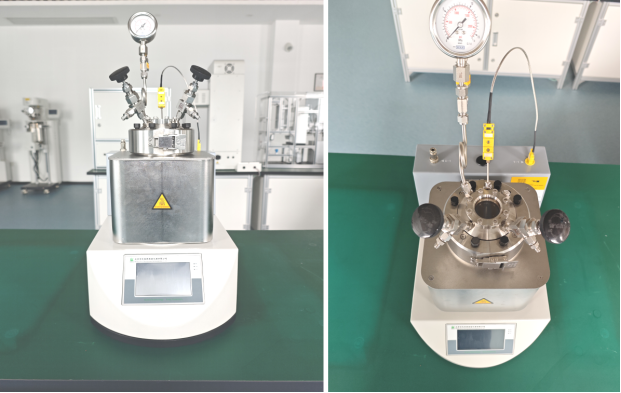
Advantages of top illuminated high-pressure photochemical reactor technology configuration:
1) Independently developed touch screen temperature control system, with dual temperature control inside and outside the kettle to prevent temperature overshoot;
2) Configure sapphire (Al2O3) crystal windows with high strength, high hardness, high temperature resistance, abrasion resistance, corrosion resistance, good light transmission performance, and excellent electrical insulation performance;
3) Internal magnetic stirring; Or paddle type mechanical stirring method;
4) The interior of the reaction vessel can be equipped with PTFE inner liner or quartz inner liner;
5) Gas solid liquid reactions can be achieved inside the kettle, as well as gas-solid reactions;
6) Realize material catalytic experiments under high pressure (<10MPa) and high temperature (<250 ℃);
7) The dual line sealing technology of snap ring solves the problem of traditional seal leakage and achieves quick disassembly and assembly;
8) Equipped with high-quality needle valves, three-way ball valves, and pressure gauges, flexible control of the kettle pressure has been achieved;
Application areas of top illuminated high-pressure photochemical reactors: Suitable for the development of photochemistry and photocatalysis, the Century Senlang LC series offers various volume configurations of photochemical high-pressure reactors, which can achieve photochemical catalysis, synthesis, degradation and other reactions under high pressure. It is used in photochemical high-pressure reaction, photocatalytic high-pressure reaction, photocatalytic carbon dioxide CO2 reduction, pollution gas degradation, VOCs photocatalytic degradation, photocatalytic gas-phase high-pressure synthesis, reduction and degradation of nitrogen oxides and NOx, high-pressure photocatalytic degradation of formaldehyde and other fields, as well as reaction visualization research, sampling analysis, multiphase behavior observation, spray observation of supercritical particle preparation, thermodynamic property research, long-term dissolution process observation, etc.
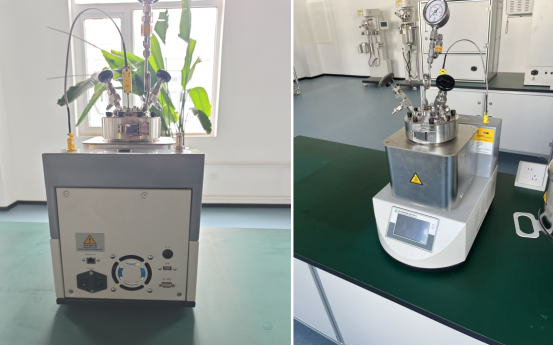
1. Photochemical reaction kettle, top illuminated 316L stainless steel material, 50ml-1000ml, including:
A. Desktop, mobile reaction kettle with kettle head
B. Full capacity of kettle: 50ml-1000ml (including PTFE inner liner and quartz inner liner)
C. The kettle lid, kettle body material, and internal components are all made of 316L stainless steel material, the window material is Sapphire material, the top window, and the opening diameter is 30mm-40mm
D. Magnetic stirrer: internal high-temperature resistant magnetic stirrer
E. Composite high-temperature sealing gasket, quick opening snap ring sealing structure, A-type double line seal
F. Working pressure/temperature: 10MPa, 250 ℃
G. The high-pressure photochemical reaction kettle cover is equipped with:
1. 0-16MPa range pressure gauge and 12.5MPa safety explosion-proof membrane (standard configuration)
2. 316L stainless steel thermocouple sleeve and K-type thermocouple, used for reaction temperature measurement
3. Liquid sampling valve (gas sampling valve) made of 316L material (needle valve), connected to a 316L material bottom tube, used for air intake, liquid intake, and liquid material extraction under pressure, equipped with a filter
4. Gas release valve (316L) (ball valve), used to vent the gas inside the reaction vessel and release pressure
H. High torque mixing drive motor: stepless speed regulation, maximum speed 0-1200 revolutions per minute
I. Mixing speed control and PID program temperature controller
J. Fixed module electric heater, heating power 1.2KW
L. Speed control and data display module
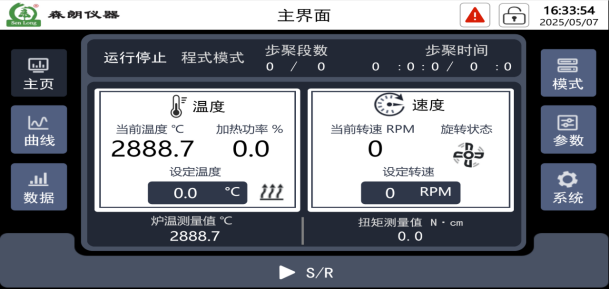
2. MRSC-LC touch screen control system: Bidirectional communication cable, realizing temperature and speed control, as well as temperature/speed/torque/timing data storage and acquisition. Dual channel internal and external temperature control monitoring, with ultra-high temperature sound and light alarm protection module; Ultra high voltage protection module.
1. Identity recognition system, graded control;
2.4.3-inch high brightness TFT display touch screen, rich and comprehensive display content, no blind spots in the field of view, graphic and textual display, vivid and simple;
2. Segmented program temperature control, with the ability to set multiple experimental conditions for temperature rise mode, using AI artificial intelligence logic PID algorithm to achieve zero overshoot and overshoot control for complex and long lag objects;
3. Real time online curve display of temperature, speed, torque, and alarm timing;
4. Automatic storage of experimental data, with built-in data recording function, can display real-time data, historical data, and provide report form recording data and alarm recording function;
5. It can be equipped with a USB drive export function, which allows for further analysis and processing on the computer, making it easy to save experimental data for a long time for use in papers, academic research, and literature;
6. Timing function: divided into two modes: constant temperature timing and working timing;
7. Power configuration: 200-240 V/AC, 50-60 Hz;
Beijing Century Senlang Company offers various types of optical reactors, including top illuminated high-pressure photochemical reactors, side illuminated high-pressure photochemical reactors, bottom illuminated high-pressure photochemical reactors, photoelectrochemical high-pressure reactors, photocatalytic reaction devices, ultra-high temperature photochemical high-pressure reactors, and customized high-temperature high-pressure photochemical reaction devices.