-
E-mail
market@aozuo.com.cn
-
Phone
15811022840
-
Address
Unit 1, 1st Floor, Building 6, Courtyard 3, Haidian District, Beijing
Beijing Aozuo Ecological Instrument Co., Ltd
Latest analysis techniques for isotopes of carbonate clusters
Date: 2025-11-07Read: 0

Researchers have developed a method using Tunable Infrared Laser Differential Absorption Spectroscopy (TILDAS) to quickly and accurately measure the isotopic composition of clusters in carbon dioxide (Δ ₆∝₈). The researchers used two infrared lasers, one at 2250.2 cm ⁻¹ and the other at 2285.1 cm ⁻¹, to directly measure the absorption spectra of four key CO ₂ isotope molecules (626, 636, 628, 638), fundamentally avoiding the interference of homosexuals in mass spectrometry. Real time analysis of the absorption peak area, deriving the reaction equilibrium constant K by calculating the ratio of ([628]/[626]) to ([638]/[636]), and ultimately converting it into the Δ ₆ ∝ ₈ value relative to the working reference gas.
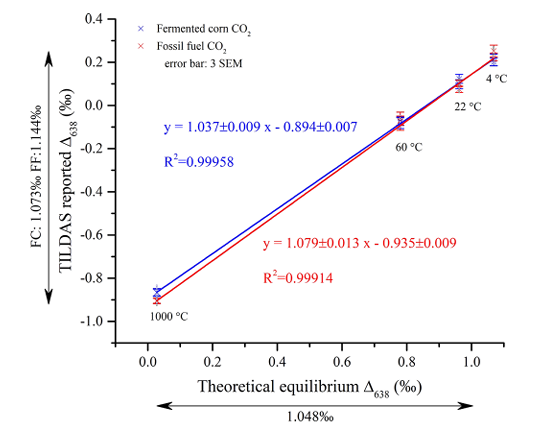
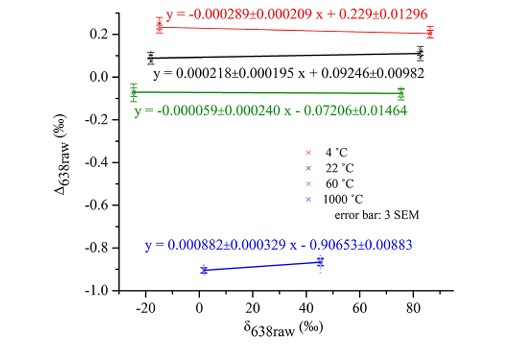
This method can achieve a standard error of ± 0.009 ‰ within 20 minutes of analysis time, with accuracy comparable to top-notch isotope ratio mass spectrometry (IRMS), but requires less sample size (15 μ mol CO ₂) and faster analysis speed. The linear relationship between the measured values of Δ ₆③₈ and the predicted values calculated based on thermodynamic theory proves the accuracy of this method. The measurement results of Δ ₆③₈ have extremely weak dependence on the overall isotopic composition (δ ¹³ C and δ ¹⁸ O) of the sample, which means that even if the background isotopic values of the sample and the reference gas differ greatly, accurate cluster isotope data can still be obtained. After rigorous testing, it was confirmed that no significant isotope fractionation was introduced during gas storage, processing, and injection, ensuring the authenticity and reliability of the analysis results.
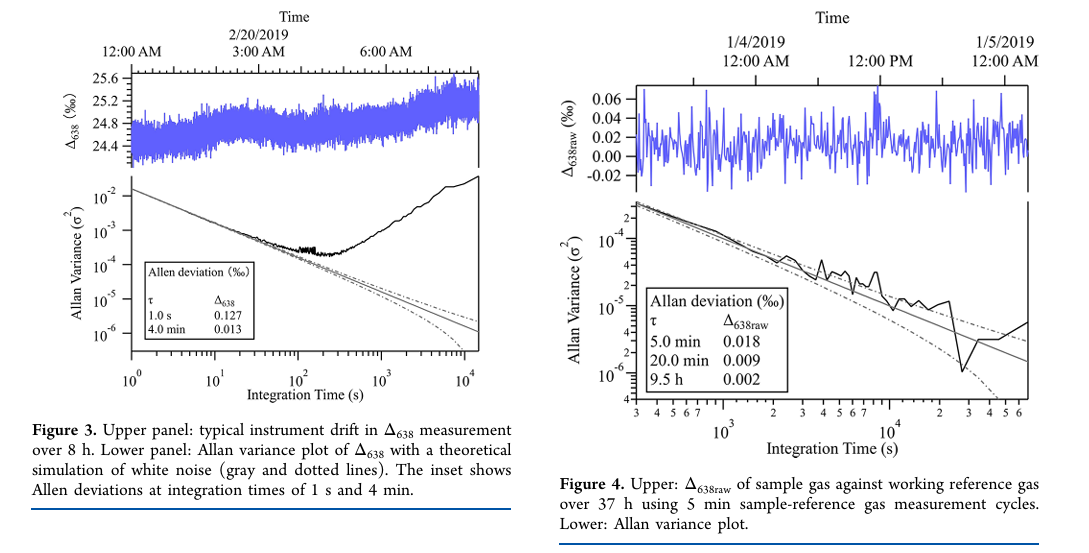
The equipment used in the above study is the TILDAS dual laser cluster isotope measurement system, which uses a 36 meter optical path multi-channel cell with a volume of approximately 250 mL. It is equipped with a high-sensitivity HgCdTe detector and an automated gas injection system, including electronic valves, pneumatic valves, critical holes, and pressure sensors, to ensure that there is no isotope fractionation during gas introduction. TDLWIntel software is used to analyze the absorption spectrum in real time, calculate the peak area ratio of each isotope, and then derive the Δ ₆ ∝ ₈ value.
The Aerodyne carbonate cluster isotope measurement system, represented by an Australian company, rapidly and accurately measures carbon dioxide cluster isotopes (Δ ₆③₈). The technical advantages of this product are as follows:
·Avoiding interference from isomers: Traditional isotope ratio mass spectrometry (IRMS) cannot distinguish between two molecules with a mass number of 47. The carbonate cluster isotope measurement system directly measures the specific infrared absorption fingerprint of the molecule, which can identify and quantify the target molecule ¹³ C ¹⁸ O ¹⁶ O without interference from other isomeric molecules, making the measurement more direct and reliable.
·High precision measurement: With a measurement time of 16 minutes and less than 1.6mg of calcite samples, the Δ ₆③₈ accuracy can reach 0.01 ‰, comparable to IRMS. While maintaining high accuracy, the cluster isotope measurement system requires less sample size and faster analysis speed, allowing scientists to conduct research with high temporal or spatial resolution and unlock trace sample analysis.
·Good accuracy: The temperature correlation is 1.028 ‰ vs 0.928 ‰, and the measurement results can track the changes in cluster isotope composition caused by temperature changes. The measured values are highly consistent with the true values, and this temperature correlation is not significantly affected by the initial source of the sample, indicating that the thermometer has a wide range of applicability.